Root Test — Question 2

PDF ↗

Question 2

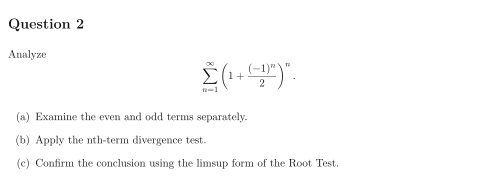
Analyze ∑n=1∞(1+(−1)n2)n.\sum_{n=1}^{\infty}\left(1+\frac{(-1)^n}{2}\right)^n.

  1. Examine the even and odd terms separately.

  2. Apply the nth-term divergence test.

  3. Confirm the conclusion using the limsup form of the Root Test.
Original worksheet page 1: question and worked solution for 4-11-002
Show solutionHide solution

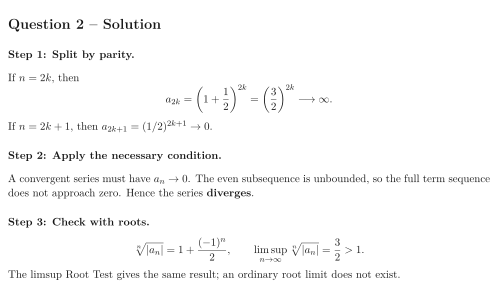
Question 2 – Solution

Step 1: Split by parity.

If n=2kn=2k, then a2k=(1+12)2k=(32)2k→∞.a_{2k}=\left(1+\frac12\right)^{2k}=\left(\frac32\right)^{2k}\longrightarrow\infty. If n=2k+1n=2k+1, then a2k+1=(1/2)2k+1→0a_{2k+1}=(1/2)^{2k+1}\to0.

Step 2: Apply the necessary condition.

A convergent series must have an→0a_n\to0. The even subsequence is unbounded, so the full term sequence does not approach zero. Hence the series diverges.

Step 3: Check with roots.

|an|n=1+(−1)n2,limsupn→∞|an|n=32>1.\sqrt[n]{|a_n|}=1+\frac{(-1)^n}{2},\qquad \limsup_{n\to\infty}\sqrt[n]{|a_n|}=\frac32>1. The limsup Root Test gives the same result; an ordinary root limit does not exist.
Original worksheet page 2: question and worked solution for 4-11-002

Original worksheet layout. Use Enlarge or open the PDF for a closer view.