Ratio Test — Question 5

PDF ↗

Question 5

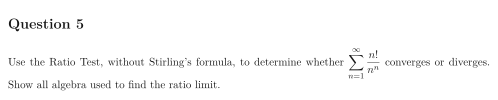
Use the Ratio Test, without Stirling’s formula, to determine whether ∑n=1∞n!nn\displaystyle\sum_{n=1}^{\infty}\frac{n!}{n^n} converges or diverges. Show all algebra used to find the ratio limit.

Original worksheet page 1: question and worked solution for 4-10-005
Show solutionHide solution

Question 5 – Solution

Step 1: Form and simplify the ratio.

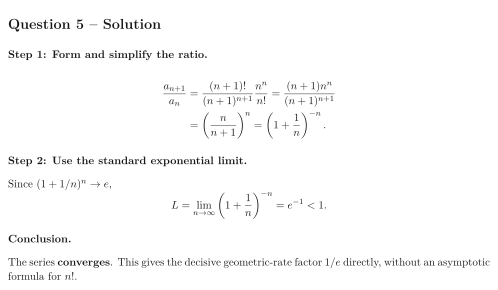
an+1an=(n+1)!(n+1)n+1nnn!=(n+1)nn(n+1)n+1=(nn+1)n=(1+1n)−n.\begin{align*} \frac{a_{n+1}}{a_n}&=\frac{(n+1)!}{(n+1)^{n+1}}\frac{n^n}{n!}=\frac{(n+1)n^n}{(n+1)^{n+1}}\\&=\left(\frac{n}{n+1}\right)^n=\left(1+\frac1n\right)^{-n}. \end{align*}

Step 2: Use the standard exponential limit.

Since (1+1/n)n→e(1+1/n)^n\to e, L=limn→∞(1+1n)−n=e−1<1.L=\lim_{n\to\infty}\left(1+\frac1n\right)^{-n}=e^{-1}<1.

Conclusion.

The series converges. This gives the decisive geometric-rate factor 1/e1/e directly, without an asymptotic formula for n!n!.

Original worksheet page 2: question and worked solution for 4-10-005

Original worksheet layout. Use Enlarge or open the PDF for a closer view.