Question 7
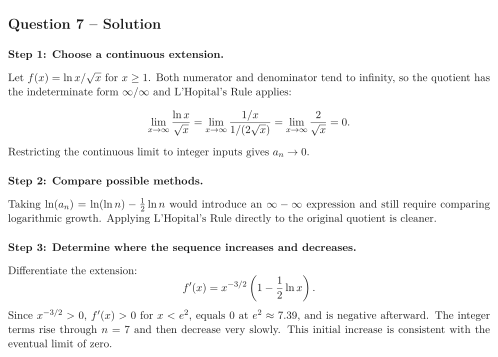
Let for .
Use a continuous extension and L’Hopital’s Rule to find the limit.
Explain why taking logarithms of is not the most direct method.
Use the derivative of to explain the initial increase of the sequence and identify where the eventual decrease begins.
Show solutionHide solution
Question 7 – Solution
Step 1: Choose a continuous extension.
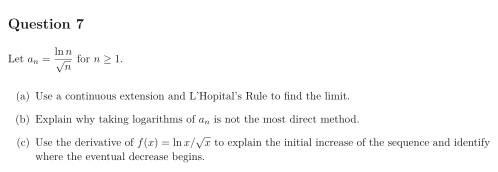
Let for . Both numerator and denominator tend to infinity, so the quotient has the indeterminate form and L’Hopital’s Rule applies: Restricting the continuous limit to integer inputs gives .
Step 2: Compare possible methods.
Taking would introduce an expression and still require comparing logarithmic growth. Applying L’Hopital’s Rule directly to the original quotient is cleaner.
Step 3: Determine where the sequence increases and decreases.
Differentiate the extension: Since , for , equals at , and is negative afterward. The integer terms rise through and then decrease very slowly. This initial increase is consistent with the eventual limit of zero.