Question 3
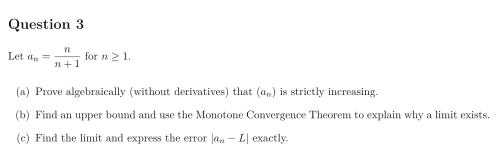
Let for .
Prove algebraically (without derivatives) that is strictly increasing.
Find an upper bound and use the Monotone Convergence Theorem to explain why a limit exists.
Find the limit and express the error exactly.
Show solutionHide solution
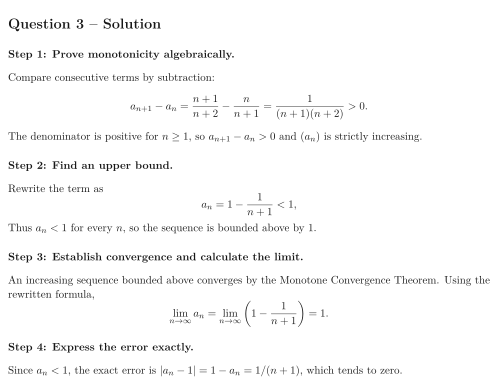
Question 3 – Solution
Step 1: Prove monotonicity algebraically.
Compare consecutive terms by subtraction: The denominator is positive for , so and is strictly increasing.
Step 2: Find an upper bound.
Rewrite the term as Thus for every , so the sequence is bounded above by .
Step 3: Establish convergence and calculate the limit.
An increasing sequence bounded above converges by the Monotone Convergence Theorem. Using the rewritten formula,
Step 4: Express the error exactly.
Since , the exact error is , which tends to zero.