Surface Area — Question 9

PDF ↗

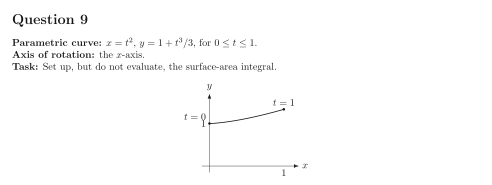
Question 9

Parametric curve: x=t2x=t^2, y=1+t3/3y=1+t^3/3, for 0≤t≤10\le t\le1.
Axis of rotation: the xx-axis.
Task: Set up, but do not evaluate, the surface-area integral.

See the diagram in the original worksheet below.
Original worksheet page 1: question and worked solution for 2-2-009
Show solutionHide solution

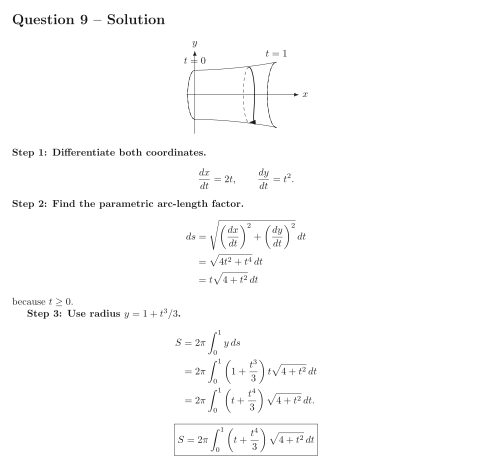
Question 9 – Solution

See the diagram in the original worksheet below.

Step 1: Differentiate both coordinates. dxdt=2t,dydt=t2.\frac{dx}{dt}=2t,\qquad\frac{dy}{dt}=t^2. Step 2: Find the parametric arc-length factor. ds=(dxdt)2+(dydt)2dt=4t2+t4dt=t4+t2dt\begin{align*} ds&=\sqrt{\left(\frac{dx}{dt}\right)^2+ \left(\frac{dy}{dt}\right)^2}\,dt\\ &=\sqrt{4t^2+t^4}\,dt\\ &=t\sqrt{4+t^2}\,dt \end{align*} because t≥0t\ge0.

Step 3: Use radius y=1+t3/3y=1+t^3/3. S=2π∫01yds=2π∫01(1+t33)t4+t2dt=2π∫01(t+t43)4+t2dt.\begin{align*} S&=2\pi\int_0^1y\,ds\\ &=2\pi\int_0^1\left(1+\frac{t^3}{3}\right) t\sqrt{4+t^2}\,dt\\ &=2\pi\int_0^1\left(t+\frac{t^4}{3}\right) \sqrt{4+t^2}\,dt. \end{align*} S=2π∫01(t+t43)4+t2dt\boxed{S=2\pi\int_0^1\left(t+\frac{t^4}{3}\right)\sqrt{4+t^2}\,dt}

Original worksheet page 2: question and worked solution for 2-2-009

Original worksheet layout. Use Enlarge or open the PDF for a closer view.