Integrals Involving Quadratics — Question 4

PDF ↗

Question 4

Find the maximum of f(x)=1/(x2−4x+8)f(x)=1/(x^2-4x+8), then evaluate ∫−∞∞f(x)dx.\int_{-\infty}^{\infty}f(x)\,dx.

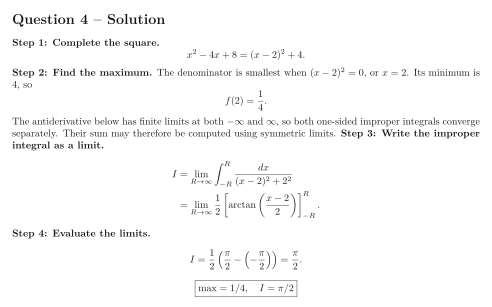
Original worksheet page 1: question and worked solution for 1-6-004
Show solutionHide solution

Question 4 – Solution

Step 1: Complete the square. x2−4x+8=(x−2)2+4.x^2-4x+8=(x-2)^2+4. Step 2: Find the maximum. The denominator is smallest when (x−2)2=0(x-2)^2=0, or x=2x=2. Its minimum is 44, so f(2)=14.f(2)=\frac14. The antiderivative below has finite limits at both −∞-\infty and ∞\infty, so both one-sided improper integrals converge separately. Their sum may therefore be computed using symmetric limits. Step 3: Write the improper integral as a limit. I=limR→∞∫−RRdx(x−2)2+22=limR→∞12[arctan(x−22)]−RR.\begin{align*} I&=\lim_{R\to\infty}\int_{-R}^{R}\frac{dx}{(x-2)^2+2^2}\\ &=\lim_{R\to\infty}\frac12 \left[\arctan\left(\frac{x-2}{2}\right)\right]_{-R}^{R}. \end{align*} Step 4: Evaluate the limits. I=12(π2−(−π2))=π2.\begin{align*} I&=\frac12\left(\frac\pi2-\left(-\frac\pi2\right)\right) =\frac\pi2. \end{align*} max⁡=1/4,I=π/2\boxed{\max=1/4,\quad I=\pi/2}

Original worksheet page 2: question and worked solution for 1-6-004

Original worksheet layout. Use Enlarge or open the PDF for a closer view.