← Mathematics Course contents Section PDF ↗ Integrals Involving Trig Functions — Question 10 Question 10
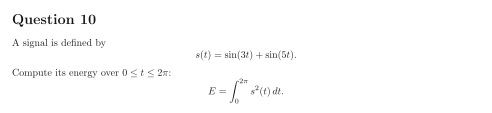
A signal is defined by
s ( t ) = sin ( 3 t ) + sin ( 5 t ) . s(t)=\sin(3t)+\sin(5t). 0 ≤ t ≤ 2 π 0\leq t\leq2\pi E = ∫ 0 2 π s 2 ( t ) d t . E=\int_0^{2\pi}s^2(t)\,dt.
Show solution Hide solution + Question 10 –
Solution
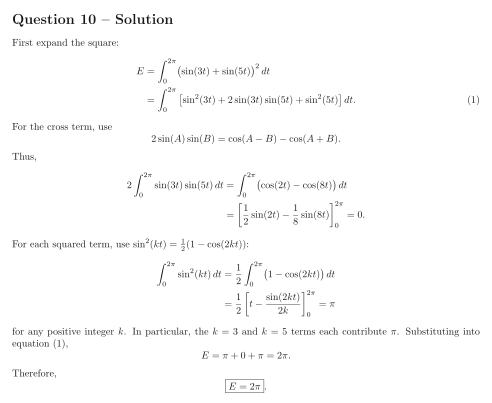
First expand the square:
E = ∫ 0 2 π ( sin ( 3 t ) + sin ( 5 t ) ) 2 d t = ∫ 0 2 π [ sin 2 ( 3 t ) + 2 sin ( 3 t ) sin ( 5 t ) + sin 2 ( 5 t ) ] d t . \begin{align*}
E
&=\int_0^{2\pi}\bigl(\sin(3t)+\sin(5t)\bigr)^2\,dt\\
&=\int_0^{2\pi}\left[\sin^2(3t)
+2\sin(3t)\sin(5t)+\sin^2(5t)\right]dt. \tag{1}
\end{align*} 2 sin ( A ) sin ( B ) = cos ( A − B ) − cos ( A + B ) . 2\sin(A)\sin(B)=\cos(A-B)-\cos(A+B). 2 ∫ 0 2 π sin ( 3 t ) sin ( 5 t ) d t = ∫ 0 2 π ( cos ( 2 t ) − cos ( 8 t ) ) d t = [ 1 2 sin ( 2 t ) − 1 8 sin ( 8 t ) ] 0 2 π = 0 . \begin{align*}
2\int_0^{2\pi}\sin(3t)\sin(5t)\,dt
&=\int_0^{2\pi}\bigl(\cos(2t)-\cos(8t)\bigr)\,dt\\
&=\left[\frac12\sin(2t)-\frac18\sin(8t)\right]_0^{2\pi}=0.
\end{align*} sin 2 ( k t ) = 1 2 ( 1 − cos ( 2 k t ) ) \sin^2(kt)=\frac12(1-\cos(2kt)) ∫ 0 2 π sin 2 ( k t ) d t = 1 2 ∫ 0 2 π ( 1 − cos ( 2 k t ) ) d t = 1 2 [ t − sin ( 2 k t ) 2 k ] 0 2 π = π \begin{align*}
\int_0^{2\pi}\sin^2(kt)\,dt
&=\frac12\int_0^{2\pi}\bigl(1-\cos(2kt)\bigr)\,dt\\
&=\frac12\left[t-\frac{\sin(2kt)}{2k}\right]_0^{2\pi}=\pi
\end{align*} k k k = 3 k=3 k = 5 k=5 π \pi E = π + 0 + π = 2 π . E=\pi+0+\pi=2\pi. E = 2 π . \boxed{E=2\pi}.
Original worksheet layout. Use Enlarge or open the PDF for a closer view.
Previous section 1-1 · Integration by PartsNext section 1-3 · Trig Substitutions