Integration by Parts — Question 1

PDF ↗

Question 1

Evaluate by tabular integration: ∫x3e2xdx.\int x^3e^{2x}\,dx.

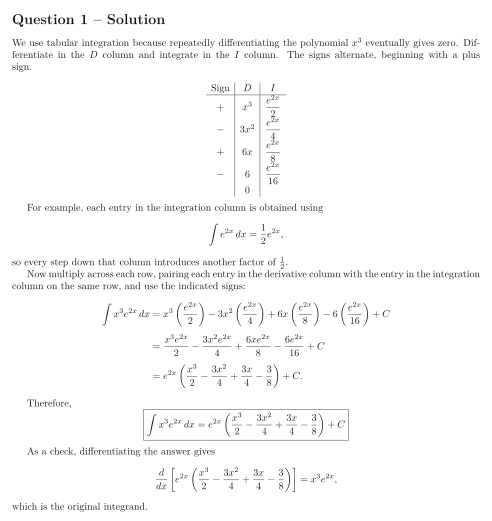
Original worksheet page 1: question and worked solution for 1-1-001
Show solutionHide solution

Question 1 – Solution

We use tabular integration because repeatedly differentiating the polynomial x3x^3 eventually gives zero. Differentiate in the DD column and integrate in the II column. The signs alternate, beginning with a plus sign.

SignDI+x3e2x2−3x2e2x4+6xe2x8−6e2x160\begin{array}{c|c|c} \text{Sign} & D & I \\ \hline + & x^3 & \dfrac{e^{2x}}{2} \\[4pt] - & 3x^2 & \dfrac{e^{2x}}{4} \\[4pt] + & 6x & \dfrac{e^{2x}}{8} \\[4pt] - & 6 & \dfrac{e^{2x}}{16} \\[4pt] & 0 & \end{array}

For example, each entry in the integration column is obtained using ∫e2xdx=12e2x,\int e^{2x}\,dx=\frac{1}{2}e^{2x}, so every step down that column introduces another factor of 12\frac12.

Now multiply across each row, pairing each entry in the derivative column with the entry in the integration column on the same row, and use the indicated signs: ∫x3e2xdx=x3(e2x2)−3x2(e2x4)+6x(e2x8)−6(e2x16)+C=x3e2x2−3x2e2x4+6xe2x8−6e2x16+C=e2x(x32−3x24+3x4−38)+C.\begin{align*} \int x^3e^{2x}\,dx &=x^3\left(\frac{e^{2x}}{2}\right) -3x^2\left(\frac{e^{2x}}{4}\right) +6x\left(\frac{e^{2x}}{8}\right) -6\left(\frac{e^{2x}}{16}\right)+C \\[4pt] &=\frac{x^3e^{2x}}{2} -\frac{3x^2e^{2x}}{4} +\frac{6xe^{2x}}{8} -\frac{6e^{2x}}{16}+C \\[4pt] &=e^{2x}\left(\frac{x^3}{2}-\frac{3x^2}{4} +\frac{3x}{4}-\frac{3}{8}\right)+C. \end{align*}

Therefore, ∫x3e2xdx=e2x(x32−3x24+3x4−38)+C\boxed{\displaystyle \int x^3e^{2x}\,dx =e^{2x}\left(\frac{x^3}{2}-\frac{3x^2}{4} +\frac{3x}{4}-\frac38\right)+C}

As a check, differentiating the answer gives ddx[e2x(x32−3x24+3x4−38)]=x3e2x,\frac{d}{dx}\left[ e^{2x}\left(\frac{x^3}{2}-\frac{3x^2}{4} +\frac{3x}{4}-\frac38\right)\right] =x^3e^{2x}, which is the original integrand.

Original worksheet page 2: question and worked solution for 1-1-001

Original worksheet layout. Use Enlarge or open the PDF for a closer view.