Constant of Integration — Question 7

PDF ↗

Question 7

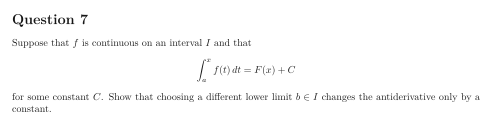
Suppose that ff is continuous on an interval II and that ∫axf(t)dt=F(x)+C\int_a^x f(t)\,dt = F(x)+C for some constant CC. Show that choosing a different lower limit b∈Ib\in I changes the antiderivative only by a constant.
Original worksheet page 1: question and worked solution for 7-9-007
Show solutionHide solution

Question 7 - Solution

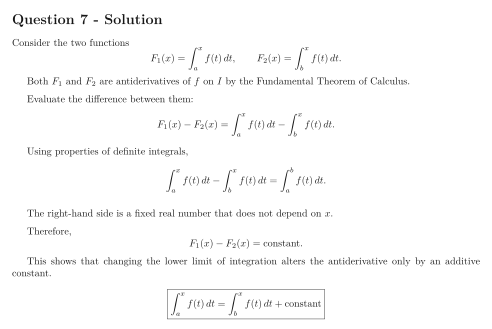
Consider the two functions F1(x)=∫axf(t)dt,F2(x)=∫bxf(t)dt.F_1(x)=\int_a^x f(t)\,dt, \qquad F_2(x)=\int_b^x f(t)\,dt.

Both F1F_1 and F2F_2 are antiderivatives of ff on II by the Fundamental Theorem of Calculus.

Evaluate the difference between them: F1(x)−F2(x)=∫axf(t)dt−∫bxf(t)dt.F_1(x)-F_2(x) = \int_a^x f(t)\,dt-\int_b^x f(t)\,dt.

Using properties of definite integrals, ∫axf(t)dt−∫bxf(t)dt=∫abf(t)dt.\int_a^x f(t)\,dt-\int_b^x f(t)\,dt = \int_a^b f(t)\,dt.

The right-hand side is a fixed real number that does not depend on xx.

Therefore, F1(x)−F2(x)=constant.F_1(x)-F_2(x)=\text{constant}.

This shows that changing the lower limit of integration alters the antiderivative only by an additive constant.
∫axf(t)dt=∫bxf(t)dt+constant\boxed{\int_a^x f(t)\,dt=\int_b^x f(t)\,dt+\text{constant}}

Original worksheet page 2: question and worked solution for 7-9-007

Original worksheet layout. Use Enlarge or open the PDF for a closer view.