Constant of Integration — Question 2

PDF ↗

Question 2

Suppose that F′(x)=0F'(x)=0 for all xx in an interval II. Prove that FF is constant on II.

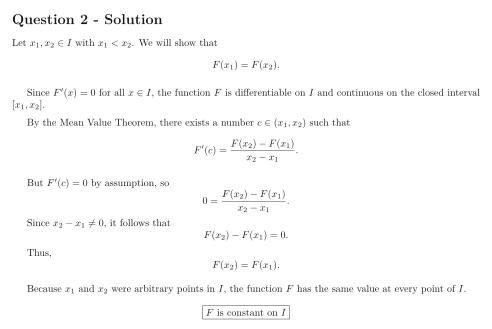
Original worksheet page 1: question and worked solution for 7-9-002
Show solutionHide solution

Question 2 - Solution

Let x1,x2∈Ix_1,x_2\in I with x1<x2x_1<x_2. We will show that F(x1)=F(x2).F(x_1)=F(x_2).

Since F′(x)=0F'(x)=0 for all x∈Ix\in I, the function FF is differentiable on II and continuous on the closed interval [x1,x2][x_1,x_2].

By the Mean Value Theorem, there exists a number c∈(x1,x2)c\in(x_1,x_2) such that F′(c)=F(x2)−F(x1)x2−x1.F'(c)=\frac{F(x_2)-F(x_1)}{x_2-x_1}.

But F′(c)=0F'(c)=0 by assumption, so 0=F(x2)−F(x1)x2−x1.0=\frac{F(x_2)-F(x_1)}{x_2-x_1}.

Since x2−x1≠0x_2-x_1\neq 0, it follows that F(x2)−F(x1)=0.F(x_2)-F(x_1)=0.

Thus, F(x2)=F(x1).F(x_2)=F(x_1).

Because x1x_1 and x2x_2 were arbitrary points in II, the function FF has the same value at every point of II.

F is constant on I\boxed{F \text{ is constant on } I}

Original worksheet page 2: question and worked solution for 7-9-002

Original worksheet layout. Use Enlarge or open the PDF for a closer view.