Summation Notation — Question 8

PDF ↗

Question 8

Prove that for any positive integer nn and real number r≠1r\neq 1, ∑k=0nrk=1−rn+11−r.\sum_{k=0}^{n} r^k=\frac{1-r^{\,n+1}}{1-r}.

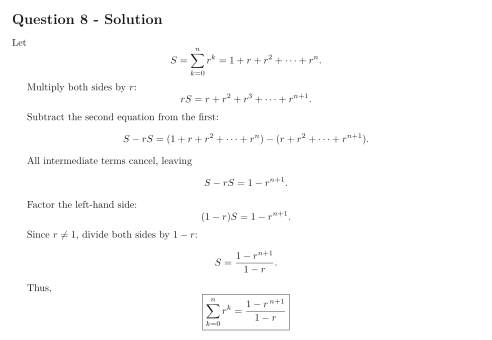
Original worksheet page 1: question and worked solution for 7-8-008
Show solutionHide solution

Question 8 - Solution

Let S=∑k=0nrk=1+r+r2+⋯+rn.S=\sum_{k=0}^{n} r^k=1+r+r^2+\cdots+r^n.

Multiply both sides by rr: rS=r+r2+r3+⋯+rn+1.rS=r+r^2+r^3+\cdots+r^{n+1}.

Subtract the second equation from the first: S−rS=(1+r+r2+⋯+rn)−(r+r2+⋯+rn+1).S-rS=(1+r+r^2+\cdots+r^n)-(r+r^2+\cdots+r^{n+1}).

All intermediate terms cancel, leaving S−rS=1−rn+1.S-rS=1-r^{n+1}.

Factor the left-hand side: (1−r)S=1−rn+1.(1-r)S=1-r^{n+1}.

Since r≠1r\neq 1, divide both sides by 1−r1-r: S=1−rn+11−r.S=\frac{1-r^{n+1}}{1-r}.

Thus, ∑k=0nrk=1−rn+11−r\boxed{\sum_{k=0}^{n} r^k=\frac{1-r^{\,n+1}}{1-r}}

Original worksheet page 2: question and worked solution for 7-8-008

Original worksheet layout. Use Enlarge or open the PDF for a closer view.