Types of Infinity — Question 10

PDF ↗

Question 10

Prove that limx→∞(xx+1)x=1e.\lim_{x\to\infty}\left(\frac{x}{x+1}\right)^x=\frac{1}{e}.

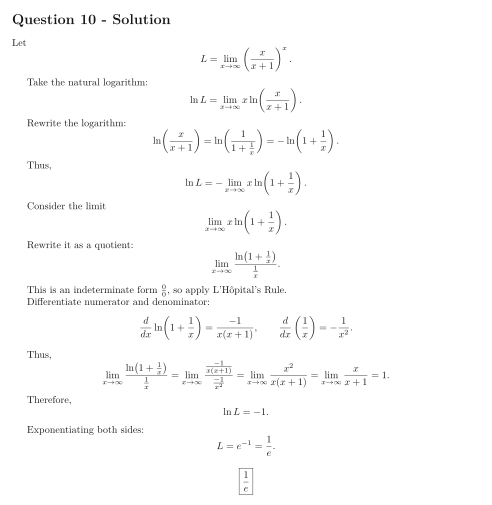
Original worksheet page 1: question and worked solution for 7-7-010
Show solutionHide solution

Question 10 - Solution

Let L=limx→∞(xx+1)x.L=\lim_{x\to\infty}\left(\frac{x}{x+1}\right)^x.

Take the natural logarithm: ln⁡L=limx→∞xln⁡(xx+1).\ln L=\lim_{x\to\infty} x\ln\!\left(\frac{x}{x+1}\right).

Rewrite the logarithm: ln⁡(xx+1)=ln⁡(11+1x)=−ln⁡(1+1x).\ln\!\left(\frac{x}{x+1}\right) = \ln\!\left(\frac{1}{1+\frac{1}{x}}\right) = -\ln\!\left(1+\frac{1}{x}\right).

Thus, ln⁡L=−limx→∞xln⁡(1+1x).\ln L = -\lim_{x\to\infty} x\ln\!\left(1+\frac{1}{x}\right).

Consider the limit limx→∞xln⁡(1+1x).\lim_{x\to\infty} x\ln\!\left(1+\frac{1}{x}\right).

Rewrite it as a quotient: limx→∞ln⁡(1+1x)1x.\lim_{x\to\infty} \frac{\ln\!\left(1+\frac{1}{x}\right)}{\frac{1}{x}}.

This is an indeterminate form 00\frac{0}{0}, so apply L’Hôpital’s Rule.

Differentiate numerator and denominator: ddxln⁡(1+1x)=−1x(x+1),ddx(1x)=−1x2.\frac{d}{dx}\ln\!\left(1+\frac{1}{x}\right) = \frac{-1}{x(x+1)}, \qquad \frac{d}{dx}\left(\frac{1}{x}\right) = -\frac{1}{x^2}.

Thus, limx→∞ln⁡(1+1x)1x=limx→∞−1x(x+1)−1x2=limx→∞x2x(x+1)=limx→∞xx+1=1.\lim_{x\to\infty} \frac{\ln\!\left(1+\frac{1}{x}\right)}{\frac{1}{x}} = \lim_{x\to\infty} \frac{\frac{-1}{x(x+1)}}{\frac{-1}{x^2}} = \lim_{x\to\infty}\frac{x^2}{x(x+1)} = \lim_{x\to\infty}\frac{x}{x+1} = 1.

Therefore, ln⁡L=−1.\ln L=-1.

Exponentiating both sides: L=e−1=1e.L=e^{-1}=\frac{1}{e}.

1e\boxed{\frac{1}{e}}

Original worksheet page 2: question and worked solution for 7-7-010

Original worksheet layout. Use Enlarge or open the PDF for a closer view.