Area and Volume Formulas — Question 2

PDF ↗

Question 2

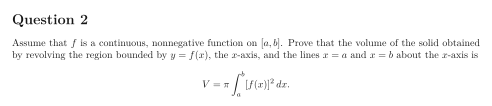
Assume that ff is a continuous, nonnegative function on [a,b][a,b]. Prove that the volume of the solid obtained by revolving the region bounded by y=f(x)y=f(x), the xx-axis, and the lines x=ax=a and x=bx=b about the xx-axis is V=π∫ab[f(x)]2dx.V=\pi\int_a^b [f(x)]^2\,dx.

Original worksheet page 1: question and worked solution for 7-6-002
Show solutionHide solution

Question 2 - Solution

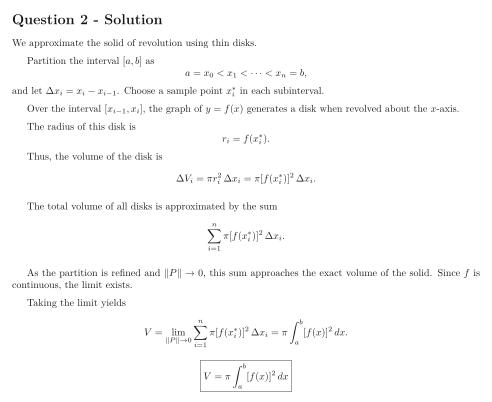
We approximate the solid of revolution using thin disks.

Partition the interval [a,b][a,b] as a=x0<x1<⋯<xn=b,a=x_0<x_1<\cdots<x_n=b, and let Δxi=xi−xi−1\Delta x_i=x_i-x_{i-1}. Choose a sample point xi*x_i^* in each subinterval.

Over the interval [xi−1,xi][x_{i-1},x_i], the graph of y=f(x)y=f(x) generates a disk when revolved about the xx-axis.

The radius of this disk is ri=f(xi*).r_i=f(x_i^*).

Thus, the volume of the disk is ΔVi=πri2Δxi=π[f(xi*)]2Δxi.\Delta V_i=\pi r_i^2\,\Delta x_i =\pi [f(x_i^*)]^2\,\Delta x_i.

The total volume of all disks is approximated by the sum ∑i=1nπ[f(xi*)]2Δxi.\sum_{i=1}^n \pi [f(x_i^*)]^2\,\Delta x_i.

As the partition is refined and ∥P∥→0\|P\|\to 0, this sum approaches the exact volume of the solid. Since ff is continuous, the limit exists.

Taking the limit yields V=lim∥P∥→0∑i=1nπ[f(xi*)]2Δxi=π∫ab[f(x)]2dx.V=\lim_{\|P\|\to 0}\sum_{i=1}^n \pi [f(x_i^*)]^2\,\Delta x_i =\pi\int_a^b [f(x)]^2\,dx.
V=π∫ab[f(x)]2dx\boxed{V=\pi\int_a^b [f(x)]^2\,dx}

Original worksheet page 2: question and worked solution for 7-6-002

Original worksheet layout. Use Enlarge or open the PDF for a closer view.