Question 8
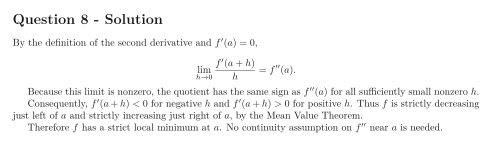
Assume that is differentiable on an open interval containing , and that Prove that has a strict local minimum at .
Show solutionHide solution
Question 8 - Solution
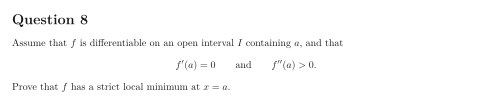
By the definition of the second derivative and ,
Because this limit is nonzero, the quotient has the same sign as for all sufficiently small nonzero .
Consequently, for negative and for positive . Thus is strictly decreasing just left of and strictly increasing just right of , by the Mean Value Theorem.
Therefore has a strict local minimum at . No continuity assumption on near is needed.