Proofs of Derivative Applications Facts — Question 3

PDF ↗

Question 3

Assume that ff is continuous on [a,b][a,b] and differentiable on (a,b)(a,b). Prove that there exists a number c∈(a,b)c\in(a,b) such that f′(c)=f(b)−f(a)b−a.f'(c)=\frac{f(b)-f(a)}{\,b-a\,}.

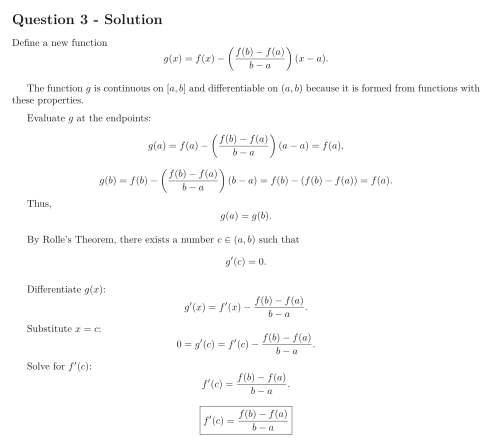
Original worksheet page 1: question and worked solution for 7-4-003
Show solutionHide solution

Question 3 - Solution

Define a new function g(x)=f(x)−(f(b)−f(a)b−a)(x−a).g(x)=f(x)-\left(\frac{f(b)-f(a)}{b-a}\right)(x-a).

The function gg is continuous on [a,b][a,b] and differentiable on (a,b)(a,b) because it is formed from functions with these properties.

Evaluate gg at the endpoints: g(a)=f(a)−(f(b)−f(a)b−a)(a−a)=f(a),g(a)=f(a)-\left(\frac{f(b)-f(a)}{b-a}\right)(a-a)=f(a), g(b)=f(b)−(f(b)−f(a)b−a)(b−a)=f(b)−(f(b)−f(a))=f(a).g(b)=f(b)-\left(\frac{f(b)-f(a)}{b-a}\right)(b-a)=f(b)-(f(b)-f(a))=f(a).

Thus, g(a)=g(b).g(a)=g(b).

By Rolle’s Theorem, there exists a number c∈(a,b)c\in(a,b) such that g′(c)=0.g'(c)=0.

Differentiate g(x)g(x): g′(x)=f′(x)−f(b)−f(a)b−a.g'(x)=f'(x)-\frac{f(b)-f(a)}{b-a}.

Substitute x=cx=c: 0=g′(c)=f′(c)−f(b)−f(a)b−a.0=g'(c)=f'(c)-\frac{f(b)-f(a)}{b-a}.

Solve for f′(c)f'(c): f′(c)=f(b)−f(a)b−a.f'(c)=\frac{f(b)-f(a)}{b-a}.

f′(c)=f(b)−f(a)b−a\boxed{f'(c)=\dfrac{f(b)-f(a)}{b-a}}

Original worksheet page 2: question and worked solution for 7-4-003

Original worksheet layout. Use Enlarge or open the PDF for a closer view.