Proof of Various Derivative Properties — Question 10

PDF ↗

Question 10

Assume that ff is differentiable at x=ax=a and that gg is differentiable at x=f(a)x=f(a). Prove the Chain Rule: (g∘f)′(a)=g′(f(a))f′(a).(g\circ f)'(a)=g'(f(a))\,f'(a).

Original worksheet page 1: question and worked solution for 7-2-010
Show solutionHide solution

Question 10 - Solution

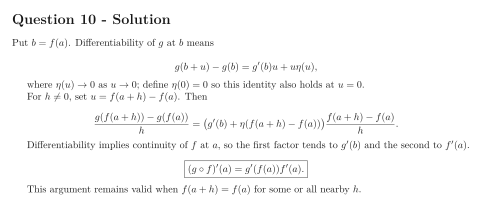
Put b=f(a)b=f(a). Differentiability of gg at bb means

g(b+u)−g(b)=g′(b)u+uη(u),g(b+u)-g(b)=g'(b)u+u\eta(u),

where η(u)→0\eta(u)\to0 as u→0u\to0; define η(0)=0\eta(0)=0 so this identity also holds at u=0u=0.

For h≠0h\ne0, set u=f(a+h)−f(a)u=f(a+h)-f(a). Then

g(f(a+h))−g(f(a))h=(g′(b)+η(f(a+h)−f(a)))f(a+h)−f(a)h.\frac{g(f(a+h))-g(f(a))}{h} =\bigl(g'(b)+\eta(f(a+h)-f(a))\bigr)\frac{f(a+h)-f(a)}h.

Differentiability implies continuity of ff at aa, so the first factor tends to g′(b)g'(b) and the second to f′(a)f'(a).

(g∘f)′(a)=g′(f(a))f′(a).\boxed{(g\circ f)'(a)=g'(f(a))f'(a).}

This argument remains valid when f(a+h)=f(a)f(a+h)=f(a) for some or all nearby hh.

Original worksheet page 2: question and worked solution for 7-2-010

Original worksheet layout. Use Enlarge or open the PDF for a closer view.