Proof of Various Limit Properties — Question 2

PDF ↗

Question 2

Assume that lim⁡x→af(x)=L\lim_{x\to a} f(x)=L and that cc is a constant. Prove that limx→a(cf(x))=cL.\lim_{x\to a} \bigl(cf(x)\bigr)=cL.

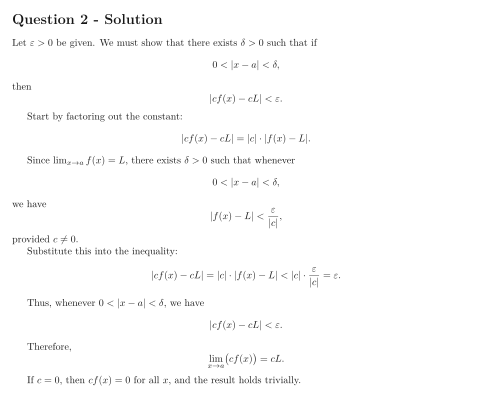
Original worksheet page 1: question and worked solution for 7-1-002
Show solutionHide solution

Question 2 - Solution

Let ε>0\varepsilon>0 be given. We must show that there exists δ>0\delta>0 such that if 0<|x−a|<δ,0<|x-a|<\delta, then |cf(x)−cL|<ε.|cf(x)-cL|<\varepsilon.

Start by factoring out the constant: |cf(x)−cL|=|c|⋅|f(x)−L|.|cf(x)-cL| = |c|\cdot|f(x)-L|.

Since lim⁡x→af(x)=L\lim_{x\to a} f(x)=L, there exists δ>0\delta>0 such that whenever 0<|x−a|<δ,0<|x-a|<\delta, we have |f(x)−L|<ε|c|,|f(x)-L|<\frac{\varepsilon}{|c|}, provided c≠0c\neq 0.

Substitute this into the inequality: |cf(x)−cL|=|c|⋅|f(x)−L|<|c|⋅ε|c|=ε.|cf(x)-cL| = |c|\cdot|f(x)-L| < |c|\cdot\frac{\varepsilon}{|c|} = \varepsilon.

Thus, whenever 0<|x−a|<δ0<|x-a|<\delta, we have |cf(x)−cL|<ε.|cf(x)-cL|<\varepsilon.

Therefore, limx→a(cf(x))=cL.\lim_{x\to a} \bigl(cf(x)\bigr)=cL.

If c=0c=0, then cf(x)=0cf(x)=0 for all xx, and the result holds trivially.

Original worksheet page 2: question and worked solution for 7-1-002

Original worksheet layout. Use Enlarge or open the PDF for a closer view.