Question 10
The base of a solid is the region bounded by between their points of intersection. Cross-sections parallel to the -axis are rectangles whose width is equal to the distance between the curves and whose height is constant and equal to . Find the volume of the solid.
See the diagram in the original worksheet below.
Shaded base region in the -plane.
Cross-section perpendicular to the -axis
See the diagram in the original worksheet below.
Schematic cross-section; dimensions vary with .

Show solutionHide solution
Question 10 – Solution
1. Interpret the slice direction and find the bounds.
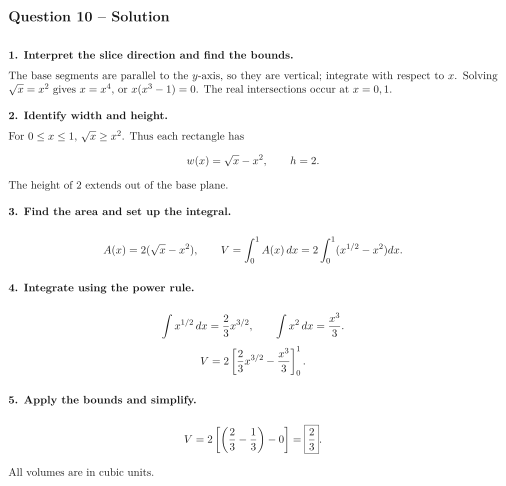
The base segments are parallel to the -axis, so they are vertical; integrate with respect to . Solving gives , or . The real intersections occur at .
2. Identify width and height.
For , . Thus each rectangle hasThe height of extends out of the base plane.
3. Find the area and set up the integral.
4. Integrate using the power rule.
5. Apply the bounds and simplify.
All volumes are in cubic units.