Question 5
The base of a solid is the region bounded by between their intersection points. Cross-sections perpendicular to the -axis are rectangles whose height is twice the base in the region. Find the volume of the solid.
See the diagram in the original worksheet below.
Shaded base region in the -plane.
Cross-section perpendicular to the -axis
See the diagram in the original worksheet below.
Schematic cross-section; dimensions vary with .

Show solutionHide solution
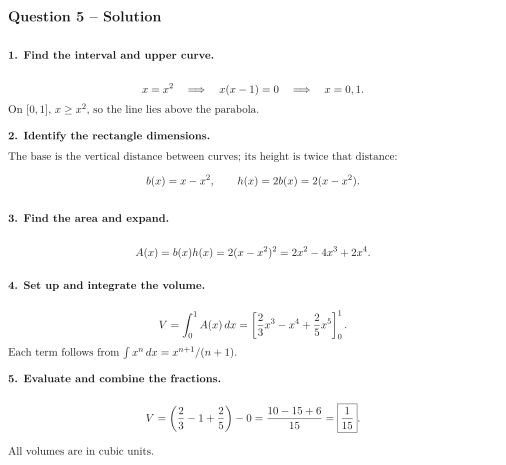
Question 5 – Solution
1. Find the interval and upper curve.
On , , so the line lies above the parabola.
2. Identify the rectangle dimensions.
The base is the vertical distance between curves; its height is twice that distance:
3. Find the area and expand.
4. Set up and integrate the volume.
Each term follows from .
5. Evaluate and combine the fractions.
All volumes are in cubic units.