More Volume Problems — Question 3

PDF ↗

Question 3

The base of a solid is the region enclosed by y=sin⁡xandy=0y=\sin x \quad \text{and} \quad y=0 from x=0x=0 to x=πx=\pi. Cross-sections perpendicular to the xx-axis are semicircles whose diameters lie in the base region. Find the volume of the solid.

See the diagram in the original worksheet below.

Shaded base region in the xyxy-plane.

Cross-section perpendicular to the xx-axis

See the diagram in the original worksheet below.

Schematic cross-section; dimensions vary with xx.

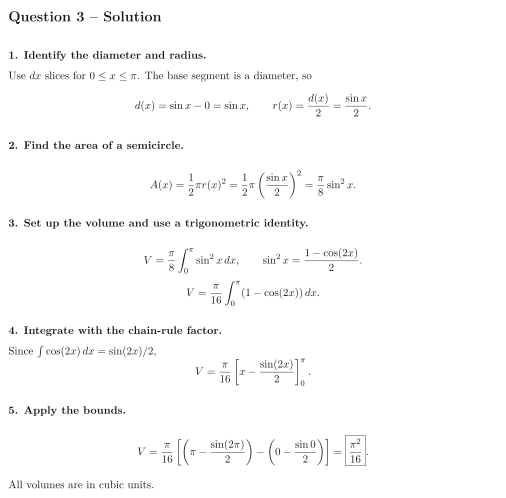
Original worksheet page 1: question and worked solution for 6-5-003
Show solutionHide solution

Question 3 – Solution

1. Identify the diameter and radius.

Use dxdx slices for 0≤x≤π0\le x\le\pi. The base segment is a diameter, sod(x)=sin⁡x−0=sin⁡x,r(x)=d(x)2=sin⁡x2.d(x)=\sin x-0=\sin x,\qquad r(x)=\frac{d(x)}2=\frac{\sin x}{2}.

2. Find the area of a semicircle.

A(x)=12πr(x)2=12π(sin⁡x2)2=π8sin⁡2x.A(x)=\frac12\pi r(x)^2=\frac12\pi\left(\frac{\sin x}{2}\right)^2=\frac\pi8\sin^2x.

3. Set up the volume and use a trigonometric identity.

V=π8∫0πsin⁡2xdx,sin⁡2x=1−cos⁡(2x)2.V=\frac\pi8\int_0^\pi\sin^2x\,dx,\qquad\sin^2x=\frac{1-\cos(2x)}2.V=π16∫0π(1−cos⁡(2x))dx.V=\frac\pi{16}\int_0^\pi(1-\cos(2x))\,dx.

4. Integrate with the chain-rule factor.

Since ∫cos⁡(2x)dx=sin⁡(2x)/2\int\cos(2x)\,dx=\sin(2x)/2,V=π16[x−sin⁡(2x)2]0π.V=\frac\pi{16}\left[x-\frac{\sin(2x)}2\right]_0^\pi.

5. Apply the bounds.

V=π16[(π−sin⁡(2π)2)−(0−sin⁡02)]=π216.V=\frac\pi{16}\left[\left(\pi-\frac{\sin(2\pi)}2\right)-\left(0-\frac{\sin0}2\right)\right]=\boxed{\frac{\pi^2}{16}}.

All volumes are in cubic units.

Original worksheet page 2: question and worked solution for 6-5-003

Original worksheet layout. Use Enlarge or open the PDF for a closer view.