More Volume Problems — Question 1

PDF ↗

Question 1

Find the volume of the solid obtained by rotating the region bounded by y=x2,y=2−x,y=x^2,\qquad y=2-x, about the xx-axis.

See the diagram in the original worksheet below.

Rotate the shaded region about the xx-axis.

Original worksheet page 1: question and worked solution for 6-5-001
Show solutionHide solution

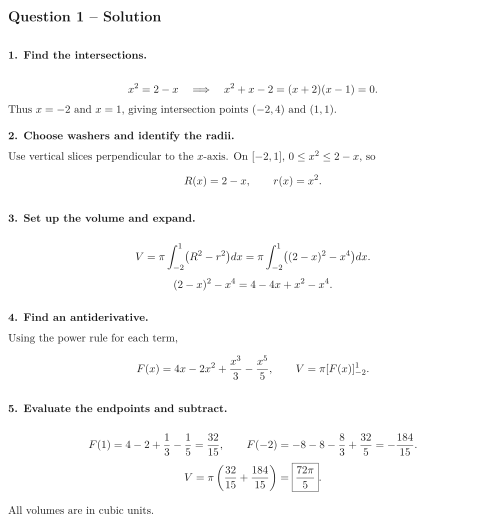
Question 1 – Solution

1. Find the intersections.

x2=2−x⇒x2+x−2=(x+2)(x−1)=0.x^2=2-x\quad\Longrightarrow\quad x^2+x-2=(x+2)(x-1)=0.Thus x=−2x=-2 and x=1x=1, giving intersection points (−2,4)(-2,4) and (1,1)(1,1).

2. Choose washers and identify the radii.

Use vertical slices perpendicular to the xx-axis. On [−2,1][-2,1], 0≤x2≤2−x0\le x^2\le2-x, soR(x)=2−x,r(x)=x2.R(x)=2-x,\qquad r(x)=x^2.

3. Set up the volume and expand.

V=π∫−21(R2−r2)dx=π∫−21((2−x)2−x4)dx.V=\pi\int_{-2}^1\bigl(R^2-r^2\bigr)dx=\pi\int_{-2}^1\bigl((2-x)^2-x^4\bigr)dx.(2−x)2−x4=4−4x+x2−x4.(2-x)^2-x^4=4-4x+x^2-x^4.

4. Find an antiderivative.

Using the power rule for each term,F(x)=4x−2x2+x33−x55,V=π[F(x)]−21.F(x)=4x-2x^2+\frac{x^3}{3}-\frac{x^5}{5},\qquad V=\pi[F(x)]_{-2}^1.

5. Evaluate the endpoints and subtract.

F(1)=4−2+13−15=3215,F(−2)=−8−8−83+325=−18415.F(1)=4-2+\frac13-\frac15=\frac{32}{15},\qquad F(-2)=-8-8-\frac83+\frac{32}{5}=-\frac{184}{15}.V=π(3215+18415)=72π5.V=\pi\left(\frac{32}{15}+\frac{184}{15}\right)=\boxed{\frac{72\pi}{5}}.

All volumes are in cubic units.

Original worksheet page 2: question and worked solution for 6-5-001

Original worksheet layout. Use Enlarge or open the PDF for a closer view.