Volumes of Solids of Revolution Method of Cylinders — Question 8

PDF ↗

Question 8

Find the volume of the solid obtained by rotating the region bounded by y=e−x,y=0,y=e^{-x}, \qquad y=0, from x=0x=0 to x=1x=1, about the yy-axis.

See the diagram in the original worksheet below.

Rotate the shaded region about the yy-axis.

Original worksheet page 1: question and worked solution for 6-4-008
Show solutionHide solution

Question 8 – Solution

1. Identify the shell radius and height.

Use vertical slices over 0≤x≤10\le x\le1, parallel to the yy-axis:r(x)=x,h(x)=e−x−0=e−x.r(x)=x,\qquad h(x)=e^{-x}-0=e^{-x}.

2. Set up the volume integral.

Circumference times height times thickness givesV=2π∫01r(x)h(x)dx=2π∫01xe−xdx.V=2\pi\int_0^1r(x)h(x)\,dx=2\pi\int_0^1xe^{-x}\,dx.

3. Apply integration by parts.

Let u=xu=x and dv=e−xdxdv=e^{-x}dx, so du=dxdu=dx and v=−e−xv=-e^{-x}:∫xe−xdx=−xe−x+∫e−xdx=−xe−x−e−x.\int xe^{-x}\,dx=-xe^{-x}+\int e^{-x}\,dx=-xe^{-x}-e^{-x}.

4. Evaluate the definite integral.

Factor the antiderivative and substitute the bounds:∫01xe−xdx=[−(x+1)e−x]01=−2e−(−1)=1−2e.\int_0^1xe^{-x}\,dx=\left[-(x+1)e^{-x}\right]_0^1=-\frac2e-(-1)=1-\frac2e.

5. Multiply by the circumference factor.

V=2π(1−2e).V=\boxed{2\pi\left(1-\frac2e\right)}.Since e>2e>2, the expression is positive, as a volume must be.

All volumes are in cubic units.
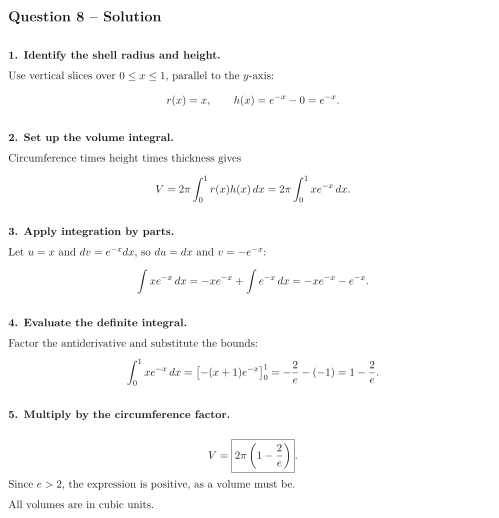
Original worksheet page 2: question and worked solution for 6-4-008

Original worksheet layout. Use Enlarge or open the PDF for a closer view.