Volumes of Solids of Revolution Method of Cylinders — Question 4

PDF ↗

Question 4

Find the volume of the solid obtained by rotating the region bounded by y=ln⁡(1+x)andy=0,y=\ln(1+x) \quad\text{and}\quad y=0, from x=0x=0 to x=e−1x=e-1, about the yy-axis.

See the diagram in the original worksheet below.

Rotate the shaded region about the yy-axis.

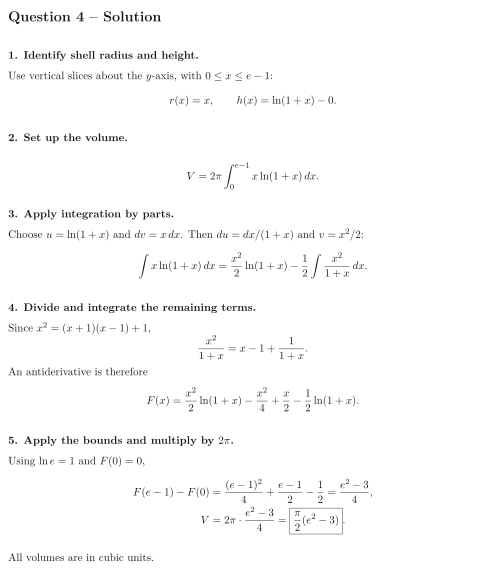
Original worksheet page 1: question and worked solution for 6-4-004
Show solutionHide solution

Question 4 – Solution

1. Identify shell radius and height.

Use vertical slices about the yy-axis, with 0≤x≤e−10\le x\le e-1:r(x)=x,h(x)=ln⁡(1+x)−0.r(x)=x,\qquad h(x)=\ln(1+x)-0.

2. Set up the volume.

V=2π∫0e−1xln⁡(1+x)dx.V=2\pi\int_0^{e-1}x\ln(1+x)\,dx.

3. Apply integration by parts.

Choose u=ln⁡(1+x)u=\ln(1+x) and dv=xdxdv=x\,dx. Then du=dx/(1+x)du=dx/(1+x) and v=x2/2v=x^2/2:∫xln⁡(1+x)dx=x22ln⁡(1+x)−12∫x21+xdx.\int x\ln(1+x)\,dx=\frac{x^2}{2}\ln(1+x)-\frac12\int\frac{x^2}{1+x}\,dx.

4. Divide and integrate the remaining terms.

Since x2=(x+1)(x−1)+1x^2=(x+1)(x-1)+1,x21+x=x−1+11+x.\frac{x^2}{1+x}=x-1+\frac1{1+x}.An antiderivative is thereforeF(x)=x22ln⁡(1+x)−x24+x2−12ln⁡(1+x).F(x)=\frac{x^2}{2}\ln(1+x)-\frac{x^2}{4}+\frac x2-\frac12\ln(1+x).

5. Apply the bounds and multiply by 2π2\pi.

Using ln⁡e=1\ln e=1 and F(0)=0F(0)=0,F(e−1)−F(0)=(e−1)24+e−12−12=e2−34,V=2π⋅e2−34=π2(e2−3).\begin{align*} F(e-1)-F(0)&=\frac{(e-1)^2}{4}+\frac{e-1}{2}-\frac12=\frac{e^2-3}{4},\\V&=2\pi\cdot\frac{e^2-3}{4}=\boxed{\frac\pi2(e^2-3)}. \end{align*}

All volumes are in cubic units.

Original worksheet page 2: question and worked solution for 6-4-004

Original worksheet layout. Use Enlarge or open the PDF for a closer view.