Area Between Curves — Question 9

PDF ↗

Question 9

Find the exact area of the region enclosed by the curves y=ln⁡(1+x)andy=x2,y=\ln(1+x) \quad\text{and}\quad y=\frac{x}{2}, between their points of intersection.

See the diagram in the original worksheet below.

The shaded region is the area to be found.

Original worksheet page 1: question and worked solution for 6-2-009
Show solutionHide solution

Question 9 – Solution

1. Describe the intersections.

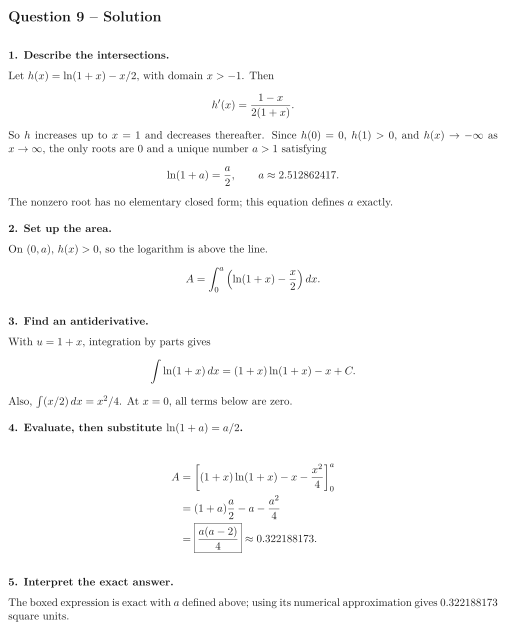
Let h(x)=ln⁡(1+x)−x/2h(x)=\ln(1+x)-x/2, with domain x>−1x>-1. Then h′(x)=1−x2(1+x).h'(x)=\frac{1-x}{2(1+x)}. So hh increases up to x=1x=1 and decreases thereafter. Since h(0)=0h(0)=0, h(1)>0h(1)>0, and h(x)→−∞h(x)\to-\infty as x→∞x\to\infty, the only roots are 00 and a unique number a>1a>1 satisfying ln⁡(1+a)=a2,a≈2.512862417.\ln(1+a)=\frac a2,\qquad a\approx2.512862417. The nonzero root has no elementary closed form; this equation defines aa exactly.

2. Set up the area.

On (0,a)(0,a), h(x)>0h(x)>0, so the logarithm is above the line. A=∫0a(ln(1+x)−x2)dx.A=\int_0^a\left(\ln(1+x)-\frac x2\right)dx.

3. Find an antiderivative.

With u=1+xu=1+x, integration by parts gives ∫ln⁡(1+x)dx=(1+x)ln⁡(1+x)−x+C.\int\ln(1+x)\,dx=(1+x)\ln(1+x)-x+C. Also, ∫(x/2)dx=x2/4\int(x/2)\,dx=x^2/4. At x=0x=0, all terms below are zero.

4. Evaluate, then substitute ln⁡(1+a)=a/2\ln(1+a)=a/2.

A=[(1+x)ln(1+x)−x−x24]0a=(1+a)a2−a−a24=a(a−2)4≈0.322188173.\begin{align*} A&=\left[(1+x)\ln(1+x)-x-\frac{x^2}{4}\right]_0^a\\ &=(1+a)\frac a2-a-\frac{a^2}{4}\\ &=\boxed{\frac{a(a-2)}4}\approx0.322188173. \end{align*}

5. Interpret the exact answer.

The boxed expression is exact with aa defined above; using its numerical approximation gives 0.3221881730.322188173 square units.

Original worksheet page 2: question and worked solution for 6-2-009

Original worksheet layout. Use Enlarge or open the PDF for a closer view.