Question 10 -
Solution
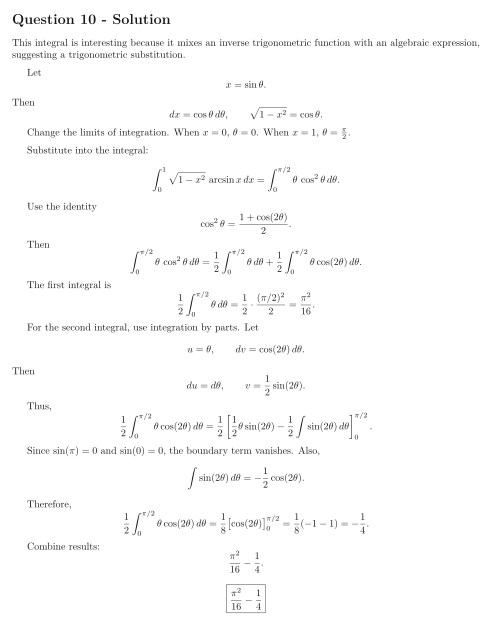
This integral is interesting because it mixes an inverse
trigonometric function with an algebraic expression, suggesting a
trigonometric substitution.
Let
Then
Change the limits of integration. When
,
.
When
,
.
Substitute into the integral:
Use the identity
Then
The first integral is
For the second integral, use integration by parts. Let
Then
Thus,
Since
and
,
the boundary term vanishes. Also,
Therefore,
Combine results: