Computing Definite Integrals — Question 9

PDF ↗

Question 9

Evaluate the definite integral ∫14(2x−1x)dx.\int_{1}^{4} \left(\frac{2}{\sqrt{x}}-\frac{1}{x}\right)\,dx.

Original worksheet page 1: question and worked solution for 5-7-009
Show solutionHide solution

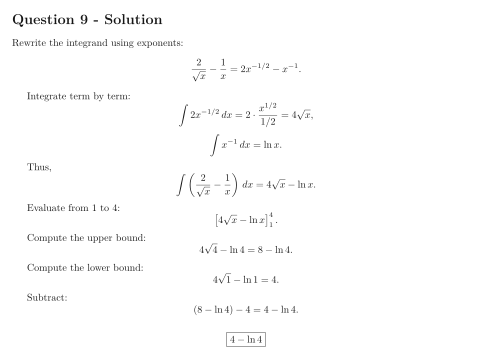
Question 9 - Solution

Rewrite the integrand using exponents: 2x−1x=2x−1/2−x−1.\frac{2}{\sqrt{x}}-\frac{1}{x} = 2x^{-1/2}-x^{-1}.

Integrate term by term: ∫2x−1/2dx=2⋅x1/21/2=4x,\int 2x^{-1/2}\,dx = 2\cdot\frac{x^{1/2}}{1/2} = 4\sqrt{x}, ∫x−1dx=ln⁡x.\int x^{-1}\,dx = \ln x.

Thus, ∫(2x−1x)dx=4x−ln⁡x.\int \left(\frac{2}{\sqrt{x}}-\frac{1}{x}\right)\,dx = 4\sqrt{x}-\ln x.

Evaluate from 11 to 44: [4x−lnx]14.\left[4\sqrt{x}-\ln x\right]_{1}^{4}.

Compute the upper bound: 44−ln⁡4=8−ln⁡4.4\sqrt{4}-\ln 4 = 8-\ln 4.

Compute the lower bound: 41−ln⁡1=4.4\sqrt{1}-\ln 1 = 4.

Subtract: (8−ln⁡4)−4=4−ln⁡4.(8-\ln 4)-4 = 4-\ln 4.

4−ln⁡4\boxed{4-\ln 4}

Original worksheet page 2: question and worked solution for 5-7-009

Original worksheet layout. Use Enlarge or open the PDF for a closer view.