Computing Definite Integrals — Question 3

PDF ↗

Question 3

Evaluate the definite integral ∫−11x21−x2dx.\int_{-1}^{1} x^2\sqrt{1-x^2}\,dx.

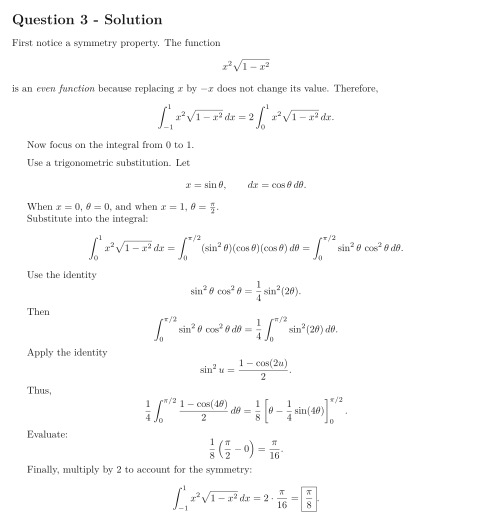
Original worksheet page 1: question and worked solution for 5-7-003
Show solutionHide solution

Question 3 - Solution

First notice a symmetry property. The function x21−x2x^2\sqrt{1-x^2} is an even function because replacing xx by −x-x does not change its value. Therefore, ∫−11x21−x2dx=2∫01x21−x2dx.\int_{-1}^{1} x^2\sqrt{1-x^2}\,dx = 2\int_{0}^{1} x^2\sqrt{1-x^2}\,dx.

Now focus on the integral from 00 to 11.

Use a trigonometric substitution. Let x=sin⁡θ,dx=cos⁡θdθ.x=\sin\theta, \qquad dx=\cos\theta\,d\theta.

When x=0x=0, θ=0\theta=0, and when x=1x=1, θ=π2\theta=\frac{\pi}{2}.

Substitute into the integral: ∫01x21−x2dx=∫0π/2(sin⁡2θ)(cos⁡θ)(cos⁡θ)dθ=∫0π/2sin⁡2θcos⁡2θdθ.\int_{0}^{1} x^2\sqrt{1-x^2}\,dx = \int_{0}^{\pi/2} (\sin^2\theta)(\cos\theta)(\cos\theta)\,d\theta = \int_{0}^{\pi/2} \sin^2\theta\,\cos^2\theta\,d\theta.

Use the identity sin⁡2θcos⁡2θ=14sin⁡2(2θ).\sin^2\theta\,\cos^2\theta = \frac{1}{4}\sin^2(2\theta).

Then ∫0π/2sin⁡2θcos⁡2θdθ=14∫0π/2sin⁡2(2θ)dθ.\int_{0}^{\pi/2} \sin^2\theta\,\cos^2\theta\,d\theta = \frac14\int_{0}^{\pi/2}\sin^2(2\theta)\,d\theta.

Apply the identity sin⁡2u=1−cos⁡(2u)2.\sin^2 u=\frac{1-\cos(2u)}{2}.

Thus, 14∫0π/21−cos⁡(4θ)2dθ=18[θ−14sin(4θ)]0π/2.\frac14\int_{0}^{\pi/2}\frac{1-\cos(4\theta)}{2}\,d\theta = \frac18\left[\theta-\frac14\sin(4\theta)\right]_{0}^{\pi/2}.

Evaluate: 18(π2−0)=π16.\frac18\left(\frac{\pi}{2}-0\right) = \frac{\pi}{16}.

Finally, multiply by 22 to account for the symmetry: ∫−11x21−x2dx=2⋅π16=π8.\int_{-1}^{1} x^2\sqrt{1-x^2}\,dx = 2\cdot\frac{\pi}{16} = \boxed{\frac{\pi}{8}}.

Original worksheet page 2: question and worked solution for 5-7-003

Original worksheet layout. Use Enlarge or open the PDF for a closer view.