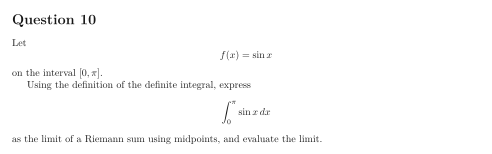
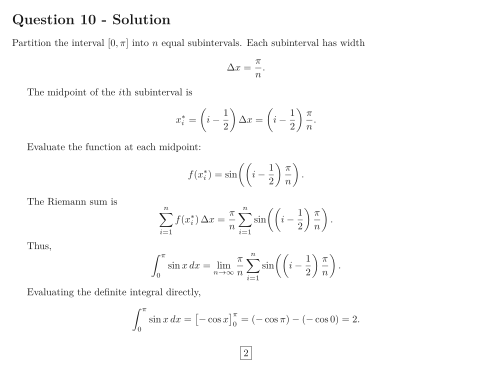
Question 10 Let f(x)=sinxf(x)=\sin x on the interval [0,π][0,\pi]. Using the definition of the definite integral, express ∫0πsinxdx\int_{0}^{\pi}\sin x\,dx as the limit of a Riemann sum using midpoints, and evaluate the limit. Show solutionHide solution+Question 10 - Solution Partition the interval [0,π][0,\pi] into nn equal subintervals. Each subinterval has width Δx=πn.\Delta x=\frac{\pi}{n}. The midpoint of the iith subinterval is xi*=(i−12)Δx=(i−12)πn.x_i^*=\left(i-\frac12\right)\Delta x =\left(i-\frac12\right)\frac{\pi}{n}. Evaluate the function at each midpoint: f(xi*)=sin((i−12)πn).f(x_i^*)=\sin\!\left(\left(i-\frac12\right)\frac{\pi}{n}\right). The Riemann sum is ∑i=1nf(xi*)Δx=πn∑i=1nsin((i−12)πn).\sum_{i=1}^{n} f(x_i^*)\,\Delta x = \frac{\pi}{n} \sum_{i=1}^{n} \sin\!\left(\left(i-\frac12\right)\frac{\pi}{n}\right). Thus, ∫0πsinxdx=limn→∞πn∑i=1nsin((i−12)πn).\int_{0}^{\pi}\sin x\,dx = \lim_{n\to\infty} \frac{\pi}{n} \sum_{i=1}^{n} \sin\!\left(\left(i-\frac12\right)\frac{\pi}{n}\right). Evaluating the definite integral directly, ∫0πsinxdx=[−cosx]0π=(−cosπ)−(−cos0)=2.\int_{0}^{\pi}\sin x\,dx = \bigl[-\cos x\bigr]_{0}^{\pi} = (-\cos\pi)-(-\cos 0) = 2. 2\boxed{2}