Definition of the Definite Integral — Question 1

PDF ↗

Question 1

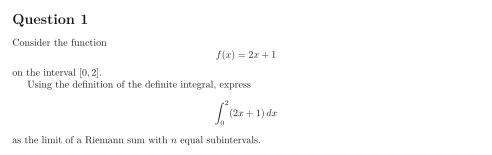
Consider the function f(x)=2x+1f(x)=2x+1 on the interval [0,2][0,2].

Using the definition of the definite integral, express ∫02(2x+1)dx\int_{0}^{2} (2x+1)\,dx as the limit of a Riemann sum with nn equal subintervals.

Original worksheet page 1: question and worked solution for 5-6-001
Show solutionHide solution

Question 1 - Solution

Divide the interval [0,2][0,2] into nn equal subintervals. Each subinterval has width Δx=2n.\Delta x=\frac{2}{n}.

Using right endpoints, the iith sample point is xi=0+iΔx=2in.x_i=0+i\Delta x=\frac{2i}{n}.

Evaluate the function at xix_i: f(xi)=2(2in)+1=4in+1.f(x_i)=2\left(\frac{2i}{n}\right)+1=\frac{4i}{n}+1.

The Riemann sum is ∑i=1nf(xi)Δx=∑i=1n(4in+1)2n.\sum_{i=1}^{n} f(x_i)\,\Delta x = \sum_{i=1}^{n}\left(\frac{4i}{n}+1\right)\frac{2}{n}.

Simplify: 2n∑i=1n(4in+1)=8n2∑i=1ni+2n∑i=1n1.\frac{2}{n}\sum_{i=1}^{n}\left(\frac{4i}{n}+1\right) = \frac{8}{n^2}\sum_{i=1}^{n} i+\frac{2}{n}\sum_{i=1}^{n}1.

Using ∑i=1ni=n(n+1)2,∑i=1n1=n,\sum_{i=1}^{n} i=\frac{n(n+1)}{2}, \qquad \sum_{i=1}^{n}1=n, we obtain 8n2⋅n(n+1)2+2n⋅n=4(1+1n)+2.\frac{8}{n^2}\cdot\frac{n(n+1)}{2}+\frac{2}{n}\cdot n = 4\left(1+\frac{1}{n}\right)+2.

Thus, ∫02(2x+1)dx=limn→∞(6+4n)=6.\int_{0}^{2}(2x+1)\,dx = \lim_{n\to\infty}\left(6+\frac{4}{n}\right)=6.

6\boxed{6}

See the diagram in the original worksheet below.
Original worksheet page 2: question and worked solution for 5-6-001

Original worksheet layout. Use Enlarge or open the PDF for a closer view.