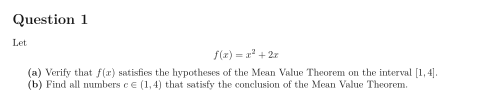
Question 1
Let
(a) Verify that satisfies the hypotheses of the Mean Value Theorem on the interval .
(b) Find all numbers that satisfy the conclusion of the Mean Value Theorem.
Show solutionHide solution
Question 1 - Solution
We are given
(a) Verifying the hypotheses
The function is a polynomial, so it is continuous on the closed interval and differentiable on the open interval .
Therefore, the hypotheses of the Mean Value Theorem are satisfied.
(b) Applying the Mean Value Theorem
First compute the derivative:
Next compute the average rate of change of on :
Set the derivative equal to this value:
Thus, the number that satisfies the conclusion of the Mean Value Theorem is
Graph of , the secant line, and the tangent line at
See the diagram in the original worksheet below.
