Question 1
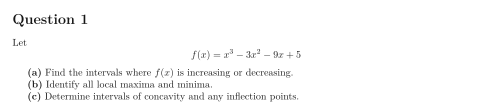
Let
(a) Find the intervals where is increasing or decreasing.
(b) Identify all local maxima and minima.
(c) Determine intervals of concavity and any inflection points.
Show solutionHide solution
Question 1 - Solution
We are given
(a) First derivative
The critical points are and .
For , the derivative is positive. For , the derivative is negative. For , the derivative is positive.
Therefore, the function is increasing on and decreasing on
(b) Local extrema
At , the function changes from increasing to decreasing, so there is a local maximum.
At , the function changes from decreasing to increasing, so there is a local minimum.
Local maximum at
Local minimum at
(c) Second derivative
Setting gives .
For , the second derivative is negative, so the graph is concave down. For , the second derivative is positive, so the graph is concave up.
The inflection point occurs at
Concave down on
Concave up on
Inflection point at
Graph of
See the diagram in the original worksheet below.
