The Shape of a Graph, Part I — Question 1

PDF ↗

Question 1

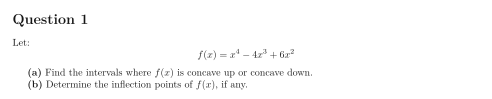
Let: f(x)=x4−4x3+6x2f(x) = x^4 - 4x^3 + 6x^2

(a) Find the intervals where f(x)f(x) is concave up or concave down.

(b) Determine the inflection points of f(x)f(x), if any.

Original worksheet page 1: question and worked solution for 4-5-001
Show solutionHide solution

Question 1 - Solution

We are given:

f(x)=x4−4x3+6x2f(x) = x^4 - 4x^3 + 6x^2

Step 1: Find the second derivative

f′(x)=4x3−12x2+12xf″(x)=12x2−24x+12=12(x−1)2\begin{aligned} f'(x) &= 4x^3 - 12x^2 + 12x \\ f''(x) &= 12x^2 - 24x + 12 = 12(x - 1)^2 \end{aligned}

(a) Since f″(x)=12(x−1)2≥0f''(x) = 12(x - 1)^2 \ge 0, the second derivative is never negative.

For all x≠1x \neq 1, f″(x)>0f''(x) > 0, so the function is concave up.

At x=1x = 1, the second derivative is zero, but the sign of f″(x)f''(x) does not change.

Answer

Concave up on (−∞,∞)\boxed{(-\infty,\infty)}

Concave down: None\boxed{\text{None}}

(b) Because the concavity does not change at x=1x = 1, there is no inflection point.

Answer

No inflection points\boxed{\text{No inflection points}}

Graph of the function

See the diagram in the original worksheet below.

Original worksheet page 2: question and worked solution for 4-5-001

Original worksheet layout. Use Enlarge or open the PDF for a closer view.