Finding Absolute Extrema — Question 5

PDF ↗

Question 5

Problem:

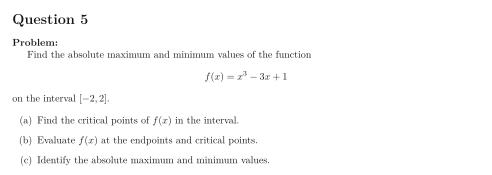
Find the absolute maximum and minimum values of the function f(x)=x3−3x+1f(x) = x^3 - 3x + 1 on the interval [−2,2][-2, 2].

  • (a) Find the critical points of f(x)f(x) in the interval.

  • (b) Evaluate f(x)f(x) at the endpoints and critical points.

  • (c) Identify the absolute maximum and minimum values.
Original worksheet page 1: question and worked solution for 4-4-005
Show solutionHide solution

Question 5 - Solution

We are given: f(x)=x3−3x+1f(x) = x^3 - 3x + 1

(a) Find critical points:

f′(x)=3x2−3=3(x2−1)=3(x−1)(x+1)f'(x) = 3x^2 - 3 = 3(x^2 - 1) = 3(x - 1)(x + 1)

Set derivative to zero: f′(x)=0⇒x=±1f'(x) = 0 \Rightarrow x = \pm 1

Critical points: x=−1x = -1, x=1x = 1

(b) Evaluate function:

f(−2)=(−2)3−3(−2)+1=−8+6+1=−1f(-2) = (-2)^3 - 3(-2) + 1 = -8 + 6 + 1 = -1 f(−1)=(−1)3−3(−1)+1=−1+3+1=3f(-1) = (-1)^3 - 3(-1) + 1 = -1 + 3 + 1 = 3 f(1)=1−3+1=−1f(1) = 1 - 3 + 1 = -1 f(2)=8−6+1=3f(2) = 8 - 6 + 1 = 3

(c) Conclusion:

  • Absolute maximum: f(−1)=f(2)=3\boxed{f(-1) = f(2) = 3}

  • Absolute minimum: f(−2)=f(1)=−1\boxed{f(-2) = f(1) = -1}

Graph of f(x)=x3−3x+1f(x) = x^3 - 3x + 1 on [−2,2][-2, 2]:

See the diagram in the original worksheet below.

Original worksheet page 2: question and worked solution for 4-4-005

Original worksheet layout. Use Enlarge or open the PDF for a closer view.