Differentials — Question 4

PDF ↗

Question 4

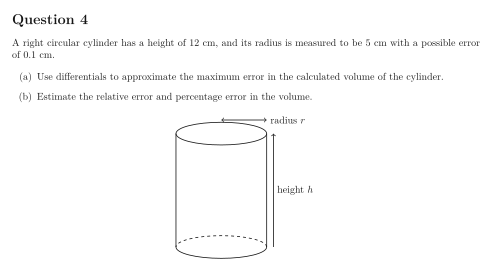
A right circular cylinder has a height of 12 cm, and its radius is measured to be 5 cm with a possible error of 0.1 cm.

  • (a) Use differentials to approximate the maximum error in the calculated volume of the cylinder.

  • (b) Estimate the relative error and percentage error in the volume.

See the diagram in the original worksheet below.
Original worksheet page 1: question and worked solution for 4-12-004
Show solutionHide solution

Question 4 - Solution

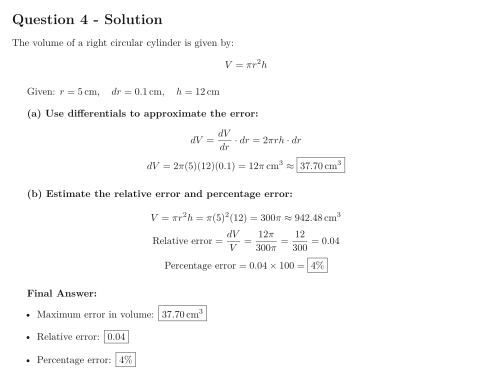
The volume of a right circular cylinder is given by: V=πr2hV = \pi r^2 h

Given: r=5cm,dr=0.1cm,h=12cmr = 5 \, \text{cm}, \quad dr = 0.1 \, \text{cm}, \quad h = 12 \, \text{cm}

(a) Use differentials to approximate the error:

dV=dVdr⋅dr=2πrh⋅drdV = \frac{dV}{dr} \cdot dr = 2\pi r h \cdot dr dV=2π(5)(12)(0.1)=12πcm3≈37.70cm3dV = 2\pi (5)(12)(0.1) = 12\pi \, \text{cm}^3 \approx \boxed{37.70 \, \text{cm}^3}

(b) Estimate the relative error and percentage error:

V=πr2h=π(5)2(12)=300π≈942.48cm3V = \pi r^2 h = \pi (5)^2 (12) = 300\pi \approx 942.48 \, \text{cm}^3 Relative error=dVV=12π300π=12300=0.04\text{Relative error} = \frac{dV}{V} = \frac{12\pi}{300\pi} = \frac{12}{300} = 0.04 Percentage error=0.04×100=4%\text{Percentage error} = 0.04 \times 100 = \boxed{4\%}

Final Answer:

  • Maximum error in volume: 37.70cm3\boxed{37.70 \, \text{cm}^3}

  • Relative error: 0.04\boxed{0.04}

  • Percentage error: 4%\boxed{4\%}

Original worksheet page 2: question and worked solution for 4-12-004

Original worksheet layout. Use Enlarge or open the PDF for a closer view.