Linear Approximations — Question 9

PDF ↗

Question 9

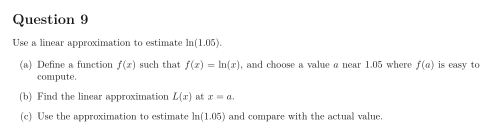
Use a linear approximation to estimate ln⁡(1.05)\ln(1.05).

  • (a) Define a function f(x)f(x) such that f(x)=ln⁡(x)f(x) = \ln(x), and choose a value aa near 1.05 where f(a)f(a) is easy to compute.

  • (b) Find the linear approximation L(x)L(x) at x=ax = a.

  • (c) Use the approximation to estimate ln⁡(1.05)\ln(1.05) and compare with the actual value.

Original worksheet page 1: question and worked solution for 4-11-009
Show solutionHide solution

Question 9 - Solution

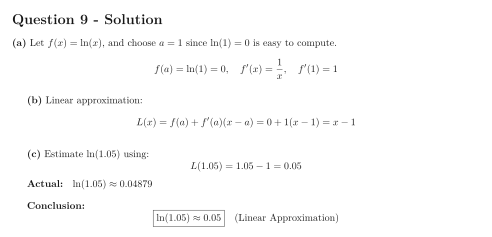
(a) Let f(x)=ln⁡(x)f(x) = \ln(x), and choose a=1a = 1 since ln⁡(1)=0\ln(1) = 0 is easy to compute.

f(a)=ln⁡(1)=0,f′(x)=1x,f′(1)=1f(a) = \ln(1) = 0, \quad f'(x) = \frac{1}{x}, \quad f'(1) = 1

(b) Linear approximation: L(x)=f(a)+f′(a)(x−a)=0+1(x−1)=x−1L(x) = f(a) + f'(a)(x - a) = 0 + 1(x - 1) = x - 1

(c) Estimate ln⁡(1.05)\ln(1.05) using: L(1.05)=1.05−1=0.05L(1.05) = 1.05 - 1 = 0.05

Actual: ln⁡(1.05)≈0.04879\ln(1.05) \approx 0.04879

Conclusion: ln⁡(1.05)≈0.05(Linear Approximation)\boxed{\ln(1.05) \approx 0.05} \quad \text{(Linear Approximation)}

Original worksheet page 2: question and worked solution for 4-11-009

Original worksheet layout. Use Enlarge or open the PDF for a closer view.