L’Hospital’s Rule and Indeterminate Forms — Question 4

PDF ↗

Question 4

Evaluate the limit: limx→0+(1+2x)1x\lim_{x \to 0^+} \left(1 + 2x\right)^{\frac{1}{x}}

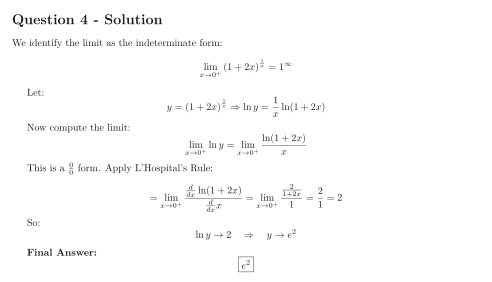
Original worksheet page 1: question and worked solution for 4-10-004
Show solutionHide solution

Question 4 - Solution

We identify the limit as the indeterminate form: limx→0+(1+2x)1x=1∞\lim_{x \to 0^+} \left(1 + 2x\right)^{\frac{1}{x}} = 1^\infty

Let: y=(1+2x)1x⇒ln⁡y=1xln⁡(1+2x)y = \left(1 + 2x\right)^{\frac{1}{x}} \Rightarrow \ln y = \frac{1}{x} \ln(1 + 2x)

Now compute the limit: limx→0+ln⁡y=limx→0+ln⁡(1+2x)x\lim_{x \to 0^+} \ln y = \lim_{x \to 0^+} \frac{\ln(1 + 2x)}{x}

This is a 00\frac{0}{0} form. Apply L’Hospital’s Rule:

=limx→0+ddxln⁡(1+2x)ddxx=limx→0+21+2x1=21=2= \lim_{x \to 0^+} \frac{\frac{d}{dx} \ln(1 + 2x)}{\frac{d}{dx} x} = \lim_{x \to 0^+} \frac{\frac{2}{1 + 2x}}{1} = \frac{2}{1} = 2

So: ln⁡y→2⇒y→e2\ln y \to 2 \quad \Rightarrow \quad y \to e^2

Final Answer: e2\boxed{e^2}

Original worksheet page 2: question and worked solution for 4-10-004

Original worksheet layout. Use Enlarge or open the PDF for a closer view.