Derivatives of Hyperbolic Functions — Question 6

PDF ↗

Question 6

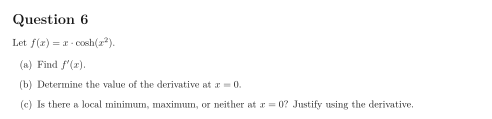
Let f(x)=x⋅cosh⁡(x2)f(x) = x \cdot \cosh(x^2).

  • (a) Find f′(x)f'(x).

  • (b) Determine the value of the derivative at x=0x = 0.

  • (c) Is there a local minimum, maximum, or neither at x=0x = 0? Justify using the derivative.

Original worksheet page 1: question and worked solution for 3-8-006
Show solutionHide solution

Question 6 - Solution

We are given: f(x)=x⋅cosh⁡(x2)f(x) = x \cdot \cosh(x^2)

(a) Find f′(x)f'(x):

This is a product of two functions: Let u=xu = x, v=cosh⁡(x2)v = \cosh(x^2)

Then: f′(x)=u′v+uv′=1⋅cosh⁡(x2)+x⋅ddx[cosh⁡(x2)]f'(x) = u'v + uv' = 1 \cdot \cosh(x^2) + x \cdot \frac{d}{dx}[\cosh(x^2)]

Differentiate cosh⁡(x2)\cosh(x^2) using the chain rule: ddx[cosh⁡(x2)]=sinh⁡(x2)⋅2x\frac{d}{dx}[\cosh(x^2)] = \sinh(x^2) \cdot 2x

So: f′(x)=cosh⁡(x2)+x⋅(2x⋅sinh(x2))=cosh⁡(x2)+2x2sinh⁡(x2)f'(x) = \cosh(x^2) + x \cdot \left(2x \cdot \sinh(x^2)\right) = \cosh(x^2) + 2x^2 \sinh(x^2)

f′(x)=cosh⁡(x2)+2x2sinh⁡(x2)\boxed{f'(x) = \cosh(x^2) + 2x^2 \sinh(x^2)}

(b) Value at x=0x = 0:

f′(0)=cosh⁡(02)+2⋅02⋅sinh⁡(02)=cosh⁡(0)=1f'(0) = \cosh(0^2) + 2 \cdot 0^2 \cdot \sinh(0^2) = \cosh(0) = 1

f′(0)=1\boxed{f'(0) = 1}

(c) Local Behavior at x=0x = 0:

Since f′(0)=1>0f'(0) = 1 > 0, the function is increasing at x=0x = 0, so:

Conclusion: There is no local minimum or maximum at x=0x = 0, because the derivative is positive and the function is increasing there.
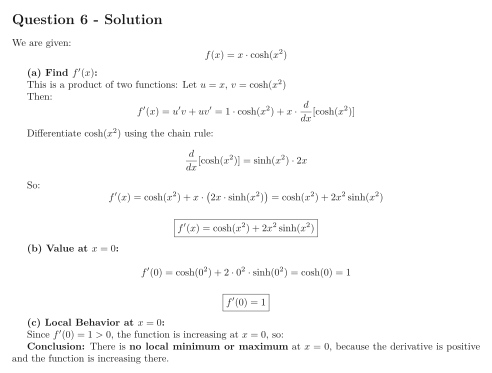
Original worksheet page 2: question and worked solution for 3-8-006

Original worksheet layout. Use Enlarge or open the PDF for a closer view.