Derivatives of Inverse Trig Functions — Question 7

PDF ↗

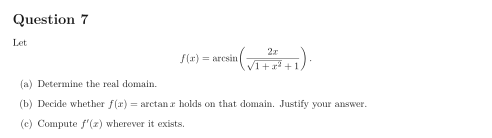
Question 7

Let f(x)=arcsin⁡(2x1+x2+1).f(x)=\arcsin\!\left(\frac{2x}{\sqrt{1+x^2}+1}\right).

  • (a) Determine the real domain.

  • (b) Decide whether f(x)=arctan⁡xf(x)=\arctan x holds on that domain. Justify your answer.

  • (c) Compute f′(x)f'(x) wherever it exists.

Original worksheet page 1: question and worked solution for 3-7-007
Show solutionHide solution

Question 7 - Solution

Domain. Let s=1+x2≥1s=\sqrt{1+x^2}\ge1. The argument of arcsin\arcsin must satisfy

4x2(s+1)2=4(s−1)s+1≤1.\frac{4x^2}{(s+1)^2}=\frac{4(s-1)}{s+1}\le1.

This is equivalent to s≤5/3s\le5/3, hence

D=[−4/3,4/3].\boxed{D=[-4/3,4/3]}.

Test the claimed identity. At x=4/3x=4/3, the arcsine is π/2\pi/2, while arctan⁡(4/3)<π/2\arctan(4/3)<\pi/2. Thus f(x)=arctan⁡xf(x)=\arctan x is false.

Differentiate. For |x|<4/3|x|<4/3, put u=2x/(s+1)u=2x/(s+1). Then

u′=2s(s+1),1−u2=5−3ss+1.u'=\frac{2}{s(s+1)},\qquad 1-u^2=\frac{5-3s}{s+1}.

Consequently

f′(x)=2ss+15−3s,s=1+x2.\boxed{f'(x)=\frac{2}{s\sqrt{s+1}\sqrt{5-3s}}},\qquad s=\sqrt{1+x^2}.

The derivative is defined on (−4/3,4/3)(-4/3,4/3) and grows without bound toward either endpoint.
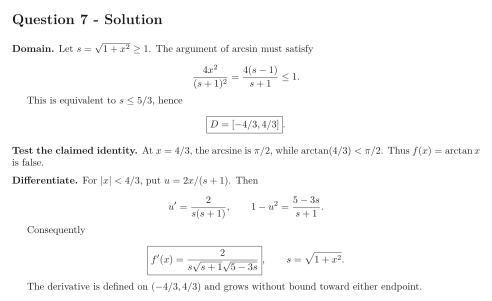
Original worksheet page 2: question and worked solution for 3-7-007

Original worksheet layout. Use Enlarge or open the PDF for a closer view.