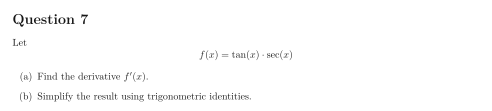
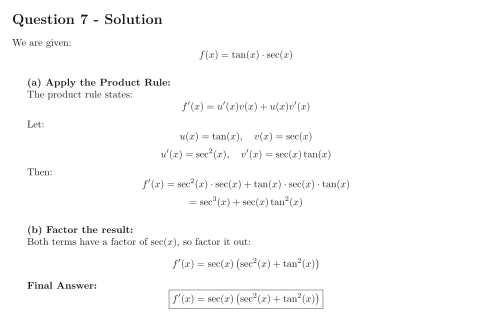
Question 7 Let f(x)=tan(x)⋅sec(x)f(x) = \tan(x) \cdot \sec(x) (a) Find the derivative f′(x)f'(x). (b) Simplify the result using trigonometric identities. Show solutionHide solution+Question 7 - Solution We are given: f(x)=tan(x)⋅sec(x)f(x) = \tan(x) \cdot \sec(x) (a) Apply the Product Rule: The product rule states: f′(x)=u′(x)v(x)+u(x)v′(x)f'(x) = u'(x)v(x) + u(x)v'(x) Let: u(x)=tan(x),v(x)=sec(x)u(x) = \tan(x), \quad v(x) = \sec(x) u′(x)=sec2(x),v′(x)=sec(x)tan(x)u'(x) = \sec^2(x), \quad v'(x) = \sec(x)\tan(x) Then: f′(x)=sec2(x)⋅sec(x)+tan(x)⋅sec(x)⋅tan(x)f'(x) = \sec^2(x) \cdot \sec(x) + \tan(x) \cdot \sec(x) \cdot \tan(x) =sec3(x)+sec(x)tan2(x)= \sec^3(x) + \sec(x)\tan^2(x) (b) Factor the result: Both terms have a factor of sec(x)\sec(x), so factor it out: f′(x)=sec(x)(sec2(x)+tan2(x))f'(x) = \sec(x)\left(\sec^2(x) + \tan^2(x)\right) Final Answer: f′(x)=sec(x)(sec2(x)+tan2(x))\boxed{f'(x) = \sec(x)\left(\sec^2(x) + \tan^2(x)\right)}