Product and Quotient Rule — Question 9

PDF ↗

Question 9

Let f(x)=(x2+1)tan⁡(x)f(x) = (x^2 + 1)\tan(x)

  • (a) Differentiate f(x)f(x) using the product rule.

  • (b) Determine all xx for which f′(x)f'(x) is undefined in the interval (−π,π)(-\pi, \pi).

Original worksheet page 1: question and worked solution for 3-4-009
Show solutionHide solution

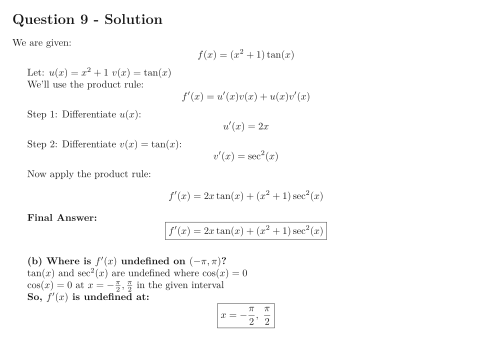
Question 9 - Solution

We are given: f(x)=(x2+1)tan⁡(x)f(x) = (x^2 + 1)\tan(x)

Let: u(x)=x2+1u(x) = x^2 + 1 v(x)=tan⁡(x)v(x) = \tan(x)

We’ll use the product rule: f′(x)=u′(x)v(x)+u(x)v′(x)f'(x) = u'(x)v(x) + u(x)v'(x)

Step 1: Differentiate u(x)u(x): u′(x)=2xu'(x) = 2x

Step 2: Differentiate v(x)=tan⁡(x)v(x) = \tan(x): v′(x)=sec⁡2(x)v'(x) = \sec^2(x)

Now apply the product rule: f′(x)=2xtan⁡(x)+(x2+1)sec⁡2(x)f'(x) = 2x \tan(x) + (x^2 + 1)\sec^2(x)

Final Answer: f′(x)=2xtan⁡(x)+(x2+1)sec⁡2(x)\boxed{ f'(x) = 2x \tan(x) + (x^2 + 1)\sec^2(x) }

(b) Where is f′(x)f'(x) undefined on (−π,π)(-\pi, \pi)?

tan⁡(x)\tan(x) and sec⁡2(x)\sec^2(x) are undefined where cos⁡(x)=0\cos(x) = 0

cos⁡(x)=0\cos(x) = 0 at x=−π2,π2x = -\frac{\pi}{2}, \frac{\pi}{2} in the given interval

So, f′(x)f'(x) is undefined at: x=−π2,π2\boxed{x = -\frac{\pi}{2}, \; \frac{\pi}{2}}

Original worksheet page 2: question and worked solution for 3-4-009

Original worksheet layout. Use Enlarge or open the PDF for a closer view.