Interpretation of the Derivative — Question 8

PDF ↗

Question 8

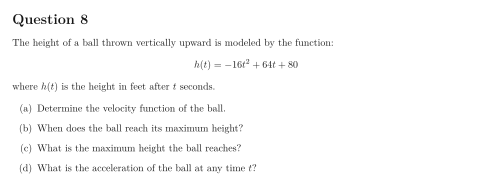
The height of a ball thrown vertically upward is modeled by the function: h(t)=−16t2+64t+80h(t) = -16t^2 + 64t + 80 where h(t)h(t) is the height in feet after tt seconds.

  • (a) Determine the velocity function of the ball.

  • (b) When does the ball reach its maximum height?

  • (c) What is the maximum height the ball reaches?

  • (d) What is the acceleration of the ball at any time tt?

Original worksheet page 1: question and worked solution for 3-2-008
Show solutionHide solution

Question 8 - Solution

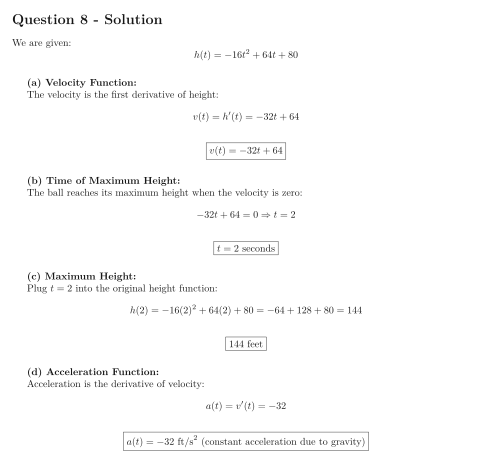
We are given: h(t)=−16t2+64t+80h(t) = -16t^2 + 64t + 80

(a) Velocity Function:

The velocity is the first derivative of height: v(t)=h′(t)=−32t+64v(t) = h'(t) = -32t + 64

v(t)=−32t+64\boxed{v(t) = -32t + 64}

(b) Time of Maximum Height:

The ball reaches its maximum height when the velocity is zero: −32t+64=0⇒t=2-32t + 64 = 0 \Rightarrow t = 2

t=2 seconds\boxed{t = 2 \text{ seconds}}

(c) Maximum Height:

Plug t=2t = 2 into the original height function: h(2)=−16(2)2+64(2)+80=−64+128+80=144h(2) = -16(2)^2 + 64(2) + 80 = -64 + 128 + 80 = 144

144 feet\boxed{144 \text{ feet}}

(d) Acceleration Function:

Acceleration is the derivative of velocity: a(t)=v′(t)=−32a(t) = v'(t) = -32
a(t)=−32 ft/s2 (constant acceleration due to gravity)\boxed{a(t) = -32 \text{ ft/s}^2 \text{ (constant acceleration due to gravity)}}

Original worksheet page 2: question and worked solution for 3-2-008

Original worksheet layout. Use Enlarge or open the PDF for a closer view.