Interpretation of the Derivative — Question 6

PDF ↗

Question 6

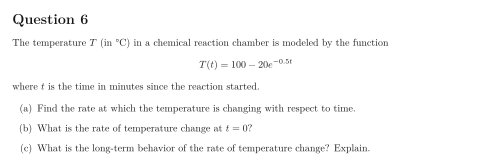
The temperature TT (in °C) in a chemical reaction chamber is modeled by the function T(t)=100−20e−0.5tT(t) = 100 - 20e^{-0.5t} where tt is the time in minutes since the reaction started.

  • (a) Find the rate at which the temperature is changing with respect to time.

  • (b) What is the rate of temperature change at t=0t = 0?

  • (c) What is the long-term behavior of the rate of temperature change? Explain.
Original worksheet page 1: question and worked solution for 3-2-006
Show solutionHide solution

Question 6 - Solution

We are given: T(t)=100−20e−0.5tT(t) = 100 - 20e^{-0.5t}

(a) Rate of Change of Temperature:

Differentiate T(t)T(t) with respect to tt:

T′(t)=ddt(100−20e−0.5t)=−20⋅ddt(e−0.5t)=−20⋅(−0.5e−0.5t)=10e−0.5tT'(t) = \frac{d}{dt}(100 - 20e^{-0.5t}) = -20 \cdot \frac{d}{dt}(e^{-0.5t}) = -20 \cdot (-0.5e^{-0.5t}) = 10e^{-0.5t}

T′(t)=10e−0.5t\boxed{T'(t) = 10e^{-0.5t}}

This represents the rate of temperature change at time tt.

(b) Rate of Change at t=0t = 0:

T′(0)=10e−0.5⋅0=10e0=10T'(0) = 10e^{-0.5 \cdot 0} = 10e^{0} = 10

T′(0)=10(°C per minute)\boxed{T'(0) = 10 \quad \text{(°C per minute)}}

Interpretation: At the beginning of the reaction, the temperature is increasing at 10°C per minute.

(c) Long-Term Behavior:

As t→∞t \to \infty, e−0.5t→0e^{-0.5t} \to 0, so:

T′(t)=10e−0.5t→0T'(t) = 10e^{-0.5t} \to 0

Conclusion: The rate of temperature change decreases over time and approaches zero. This means the temperature stabilizes and stops changing as time progresses.
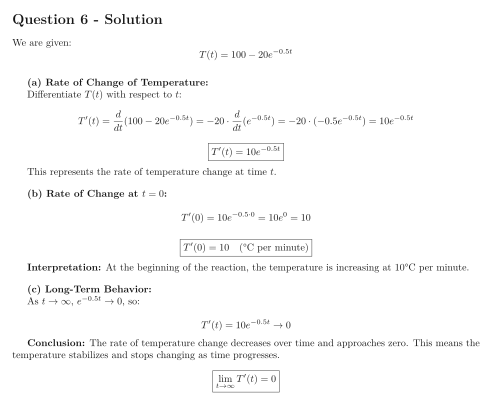
limt→∞T′(t)=0\boxed{\lim_{t \to \infty} T'(t) = 0}

Original worksheet page 2: question and worked solution for 3-2-006

Original worksheet layout. Use Enlarge or open the PDF for a closer view.