Interpretation of the Derivative — Question 3

PDF ↗

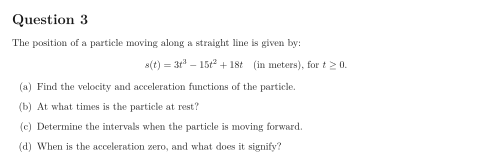
Question 3

The position of a particle moving along a straight line is given by: s(t)=3t3−15t2+18t(in meters), for t≥0.s(t) = 3t^3 - 15t^2 + 18t \quad \text{(in meters), for } t \geq 0.

  • (a) Find the velocity and acceleration functions of the particle.

  • (b) At what times is the particle at rest?

  • (c) Determine the intervals when the particle is moving forward.

  • (d) When is the acceleration zero, and what does it signify?
Original worksheet page 1: question and worked solution for 3-2-003
Show solutionHide solution

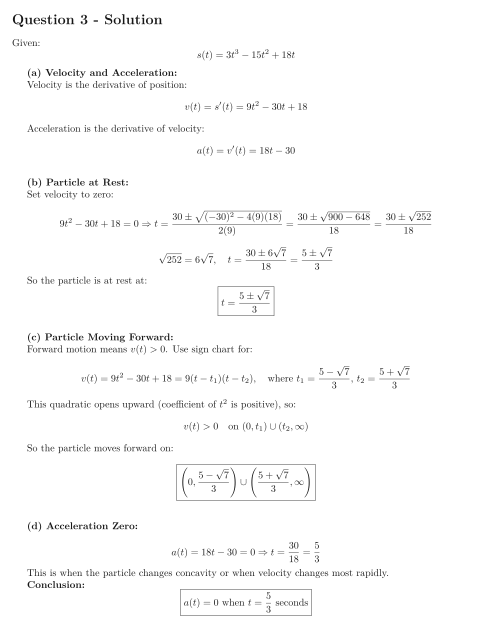
Question 3 - Solution

Given: s(t)=3t3−15t2+18ts(t) = 3t^3 - 15t^2 + 18t

(a) Velocity and Acceleration:

Velocity is the derivative of position: v(t)=s′(t)=9t2−30t+18v(t) = s'(t) = 9t^2 - 30t + 18

Acceleration is the derivative of velocity: a(t)=v′(t)=18t−30a(t) = v'(t) = 18t - 30

(b) Particle at Rest:

Set velocity to zero: 9t2−30t+18=0⇒t=30±(−30)2−4(9)(18)2(9)=30±900−64818=30±252189t^2 - 30t + 18 = 0 \Rightarrow t = \frac{30 \pm \sqrt{(-30)^2 - 4(9)(18)}}{2(9)} = \frac{30 \pm \sqrt{900 - 648}}{18} = \frac{30 \pm \sqrt{252}}{18} 252=67,t=30±6718=5±73\sqrt{252} = 6\sqrt{7}, \quad t = \frac{30 \pm 6\sqrt{7}}{18} = \frac{5 \pm \sqrt{7}}{3}

So the particle is at rest at: t=5±73\boxed{t = \frac{5 \pm \sqrt{7}}{3}}

(c) Particle Moving Forward:

Forward motion means v(t)>0v(t) > 0. Use sign chart for: v(t)=9t2−30t+18=9(t−t1)(t−t2),where t1=5−73,t2=5+73v(t) = 9t^2 - 30t + 18 = 9(t - t_1)(t - t_2), \quad \text{where } t_1 = \frac{5 - \sqrt{7}}{3}, \, t_2 = \frac{5 + \sqrt{7}}{3}

This quadratic opens upward (coefficient of t2t^2 is positive), so: v(t)>0on (0,t1)∪(t2,∞)v(t) > 0 \quad \text{on } (0, t_1) \cup (t_2, \infty)

So the particle moves forward on: (0,5−73)∪(5+73,∞)\boxed{\left(0, \frac{5 - \sqrt{7}}{3}\right) \cup \left(\frac{5 + \sqrt{7}}{3}, \infty\right)}

(d) Acceleration Zero:

a(t)=18t−30=0⇒t=3018=53a(t) = 18t - 30 = 0 \Rightarrow t = \frac{30}{18} = \frac{5}{3}

This is when the particle changes concavity or when velocity changes most rapidly.

Conclusion: a(t)=0 when t=53 seconds\boxed{a(t) = 0 \text{ when } t = \frac{5}{3} \text{ seconds}}
Original worksheet page 2: question and worked solution for 3-2-003

Original worksheet layout. Use Enlarge or open the PDF for a closer view.