Interpretation of the Derivative — Question 1

PDF ↗

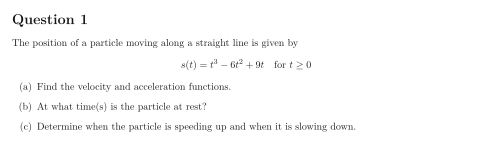
Question 1

The position of a particle moving along a straight line is given by s(t)=t3−6t2+9tfor t≥0s(t) = t^3 - 6t^2 + 9t \quad \text{for } t \geq 0

  • (a) Find the velocity and acceleration functions.

  • (b) At what time(s) is the particle at rest?

  • (c) Determine when the particle is speeding up and when it is slowing down.
Original worksheet page 1: question and worked solution for 3-2-001
Show solutionHide solution

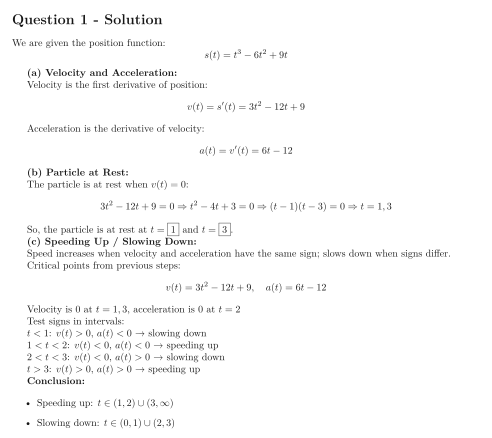
Question 1 - Solution

We are given the position function: s(t)=t3−6t2+9ts(t) = t^3 - 6t^2 + 9t

(a) Velocity and Acceleration:

Velocity is the first derivative of position: v(t)=s′(t)=3t2−12t+9v(t) = s'(t) = 3t^2 - 12t + 9

Acceleration is the derivative of velocity: a(t)=v′(t)=6t−12a(t) = v'(t) = 6t - 12

(b) Particle at Rest:

The particle is at rest when v(t)=0v(t) = 0: 3t2−12t+9=0⇒t2−4t+3=0⇒(t−1)(t−3)=0⇒t=1,33t^2 - 12t + 9 = 0 \Rightarrow t^2 - 4t + 3 = 0 \Rightarrow (t - 1)(t - 3) = 0 \Rightarrow t = 1, 3

So, the particle is at rest at t=1t = \boxed{1} and t=3t = \boxed{3}.

(c) Speeding Up / Slowing Down:

Speed increases when velocity and acceleration have the same sign; slows down when signs differ.

Critical points from previous steps: v(t)=3t2−12t+9,a(t)=6t−12v(t) = 3t^2 - 12t + 9, \quad a(t) = 6t - 12

Velocity is 0 at t=1,3t = 1, 3, acceleration is 0 at t=2t = 2

Test signs in intervals:

t<1t < 1: v(t)>0v(t) > 0, a(t)<0a(t) < 0 → slowing down

1<t<21 < t < 2: v(t)<0v(t) < 0, a(t)<0a(t) < 0 → speeding up

2<t<32 < t < 3: v(t)<0v(t) < 0, a(t)>0a(t) > 0 → slowing down

t>3t > 3: v(t)>0v(t) > 0, a(t)>0a(t) > 0 → speeding up

Conclusion:

  • Speeding up: t∈(1,2)∪(3,∞)t \in (1, 2) \cup (3, \infty)

  • Slowing down: t∈(0,1)∪(2,3)t \in (0, 1) \cup (2, 3)

Original worksheet page 2: question and worked solution for 3-2-001

Original worksheet layout. Use Enlarge or open the PDF for a closer view.