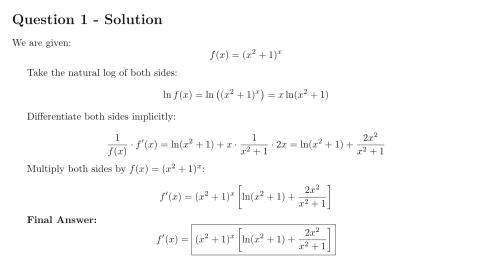
Question 1 Use logarithmic differentiation to find the derivative of: f(x)=(x2+1)xf(x) = (x^2 + 1)^x Simplify your answer as much as possible. Show solutionHide solution+Question 1 - Solution We are given: f(x)=(x2+1)xf(x) = (x^2 + 1)^x Take the natural log of both sides: lnf(x)=ln((x2+1)x)=xln(x2+1)\ln f(x) = \ln\left((x^2 + 1)^x\right) = x \ln(x^2 + 1) Differentiate both sides implicitly: 1f(x)⋅f′(x)=ln(x2+1)+x⋅1x2+1⋅2x=ln(x2+1)+2x2x2+1\frac{1}{f(x)} \cdot f'(x) = \ln(x^2 + 1) + x \cdot \frac{1}{x^2 + 1} \cdot 2x = \ln(x^2 + 1) + \frac{2x^2}{x^2 + 1} Multiply both sides by f(x)=(x2+1)xf(x) = (x^2 + 1)^x: f′(x)=(x2+1)x[ln(x2+1)+2x2x2+1]f'(x) = (x^2 + 1)^x \left[ \ln(x^2 + 1) + \frac{2x^2}{x^2 + 1} \right] Final Answer: f′(x)=(x2+1)x[ln(x2+1)+2x2x2+1]f'(x) = \boxed{(x^2 + 1)^x \left[ \ln(x^2 + 1) + \frac{2x^2}{x^2 + 1} \right]}