Higher Order Derivatives — Question 6

PDF ↗

Question 6

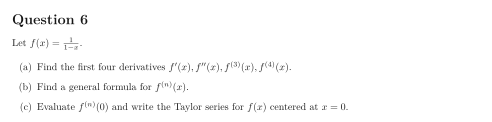
Let f(x)=11−xf(x) = \frac{1}{1 - x}.

  • (a) Find the first four derivatives f′(x),f″(x),f(3)(x),f(4)(x)f'(x), f''(x), f^{(3)}(x), f^{(4)}(x).

  • (b) Find a general formula for f(n)(x)f^{(n)}(x).

  • (c) Evaluate f(n)(0)f^{(n)}(0) and write the Taylor series for f(x)f(x) centered at x=0x = 0.

Original worksheet page 1: question and worked solution for 3-12-006
Show solutionHide solution

Question 6 - Solution

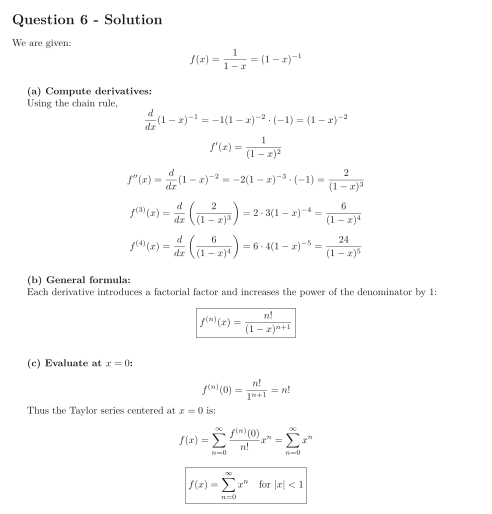
We are given: f(x)=11−x=(1−x)−1f(x) = \frac{1}{1 - x} = (1 - x)^{-1}

(a) Compute derivatives:

Using the chain rule, ddx(1−x)−1=−1(1−x)−2⋅(−1)=(1−x)−2\frac{d}{dx}(1 - x)^{-1} = -1(1 - x)^{-2} \cdot (-1) = (1 - x)^{-2} f′(x)=1(1−x)2f'(x) = \frac{1}{(1 - x)^2}

f″(x)=ddx(1−x)−2=−2(1−x)−3⋅(−1)=2(1−x)3f''(x) = \frac{d}{dx}(1 - x)^{-2} = -2(1 - x)^{-3} \cdot (-1) = \frac{2}{(1 - x)^3}

f(3)(x)=ddx(2(1−x)3)=2⋅3(1−x)−4=6(1−x)4f^{(3)}(x) = \frac{d}{dx}\left( \frac{2}{(1 - x)^3} \right) = 2 \cdot 3 (1 - x)^{-4} = \frac{6}{(1 - x)^4}

f(4)(x)=ddx(6(1−x)4)=6⋅4(1−x)−5=24(1−x)5f^{(4)}(x) = \frac{d}{dx}\left( \frac{6}{(1 - x)^4} \right) = 6 \cdot 4 (1 - x)^{-5} = \frac{24}{(1 - x)^5}

(b) General formula:

Each derivative introduces a factorial factor and increases the power of the denominator by 1: f(n)(x)=n!(1−x)n+1\boxed{f^{(n)}(x) = \frac{n!}{(1 - x)^{n + 1}}}

(c) Evaluate at x=0x = 0:

f(n)(0)=n!1n+1=n!f^{(n)}(0) = \frac{n!}{1^{n+1}} = n!

Thus the Taylor series centered at x=0x = 0 is: f(x)=∑n=0∞f(n)(0)n!xn=∑n=0∞xnf(x) = \sum_{n=0}^{\infty} \frac{f^{(n)}(0)}{n!} x^n = \sum_{n=0}^{\infty} x^n

f(x)=∑n=0∞xnfor |x|<1\boxed{f(x) = \sum_{n=0}^{\infty} x^n \quad \text{for } |x| < 1}

Original worksheet page 2: question and worked solution for 3-12-006

Original worksheet layout. Use Enlarge or open the PDF for a closer view.