Continuity — Question 1

PDF ↗

Question 1

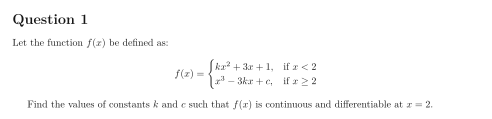
Let the function f(x)f(x) be defined as: f(x)={kx2+3x+1,if x<2x3−3kx+c,if x≥2f(x) = \begin{cases} kx^2 + 3x + 1, & \text{if } x < 2 \\ x^3 - 3kx + c, & \text{if } x \geq 2 \end{cases}

Find the values of constants kk and cc such that f(x)f(x) is continuous and differentiable at x=2x = 2.

Original worksheet page 1: question and worked solution for 2-9-001
Show solutionHide solution

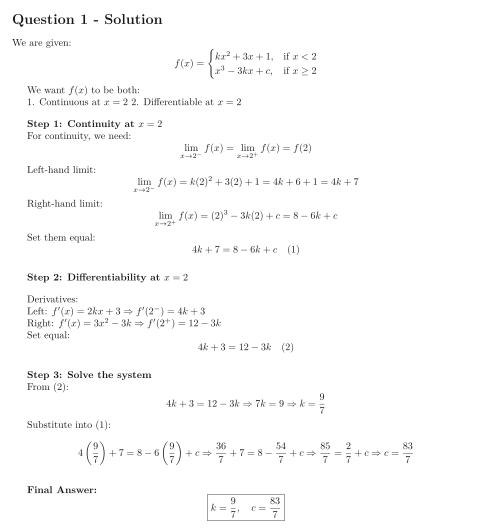
Question 1 - Solution

We are given: f(x)={kx2+3x+1,if x<2x3−3kx+c,if x≥2f(x) = \begin{cases} kx^2 + 3x + 1, & \text{if } x < 2 \\ x^3 - 3kx + c, & \text{if } x \geq 2 \end{cases}

We want f(x)f(x) to be both:

1. Continuous at x=2x = 2 2. Differentiable at x=2x = 2

Step 1: Continuity at x=2x = 2

For continuity, we need: limx→2−f(x)=limx→2+f(x)=f(2)\lim_{x \to 2^-} f(x) = \lim_{x \to 2^+} f(x) = f(2)

Left-hand limit: limx→2−f(x)=k(2)2+3(2)+1=4k+6+1=4k+7\lim_{x \to 2^-} f(x) = k(2)^2 + 3(2) + 1 = 4k + 6 + 1 = 4k + 7

Right-hand limit: limx→2+f(x)=(2)3−3k(2)+c=8−6k+c\lim_{x \to 2^+} f(x) = (2)^3 - 3k(2) + c = 8 - 6k + c

Set them equal: 4k+7=8−6k+c(1)4k + 7 = 8 - 6k + c \quad \text{(1)}

Step 2: Differentiability at x=2x = 2

Derivatives:

Left: f′(x)=2kx+3⇒f′(2−)=4k+3f'(x) = 2kx + 3 \Rightarrow f'(2^-) = 4k + 3

Right: f′(x)=3x2−3k⇒f′(2+)=12−3kf'(x) = 3x^2 - 3k \Rightarrow f'(2^+) = 12 - 3k

Set equal: 4k+3=12−3k(2)4k + 3 = 12 - 3k \quad \text{(2)}

Step 3: Solve the system

From (2): 4k+3=12−3k⇒7k=9⇒k=974k + 3 = 12 - 3k \Rightarrow 7k = 9 \Rightarrow k = \frac{9}{7}

Substitute into (1): 4(97)+7=8−6(97)+c⇒367+7=8−547+c⇒857=27+c⇒c=8374\left(\frac{9}{7}\right) + 7 = 8 - 6\left(\frac{9}{7}\right) + c \Rightarrow \frac{36}{7} + 7 = 8 - \frac{54}{7} + c \Rightarrow \frac{85}{7} = \frac{2}{7} + c \Rightarrow c = \frac{83}{7}

Final Answer: k=97,c=837\boxed{k = \frac{9}{7}, \quad c = \frac{83}{7}}

Original worksheet page 2: question and worked solution for 2-9-001

Original worksheet layout. Use Enlarge or open the PDF for a closer view.