Limits Properties — Question 10

PDF ↗

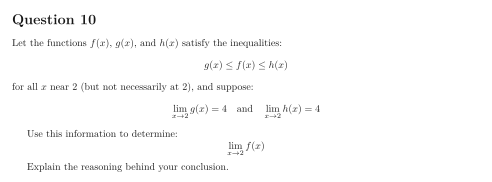
Question 10

Let the functions f(x)f(x), g(x)g(x), and h(x)h(x) satisfy the inequalities: g(x)≤f(x)≤h(x)g(x) \leq f(x) \leq h(x) for all xx near 2 (but not necessarily at 2), and suppose: limx→2g(x)=4andlimx→2h(x)=4\lim_{x \to 2} g(x) = 4 \quad \text{and} \quad \lim_{x \to 2} h(x) = 4

Use this information to determine: limx→2f(x)\lim_{x \to 2} f(x)

Explain the reasoning behind your conclusion.
Original worksheet page 1: question and worked solution for 2-4-010
Show solutionHide solution

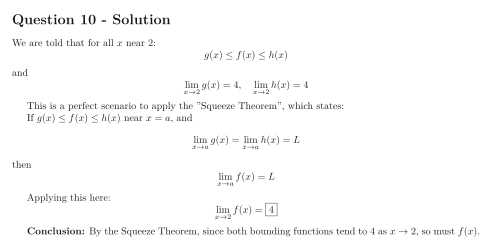
Question 10 - Solution

We are told that for all xx near 2: g(x)≤f(x)≤h(x)g(x) \leq f(x) \leq h(x) and limx→2g(x)=4,limx→2h(x)=4\lim_{x \to 2} g(x) = 4, \quad \lim_{x \to 2} h(x) = 4

This is a perfect scenario to apply the "Squeeze Theorem", which states:

If g(x)≤f(x)≤h(x)g(x) \leq f(x) \leq h(x) near x=ax = a, and limx→ag(x)=limx→ah(x)=L\lim_{x \to a} g(x) = \lim_{x \to a} h(x) = L then limx→af(x)=L\lim_{x \to a} f(x) = L

Applying this here: limx→2f(x)=4\lim_{x \to 2} f(x) = \boxed{4}

Conclusion: By the Squeeze Theorem, since both bounding functions tend to 4 as x→2x \to 2, so must f(x)f(x).

Original worksheet page 2: question and worked solution for 2-4-010

Original worksheet layout. Use Enlarge or open the PDF for a closer view.