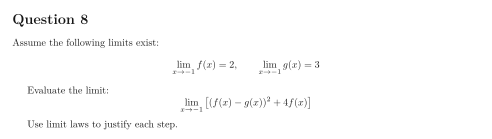
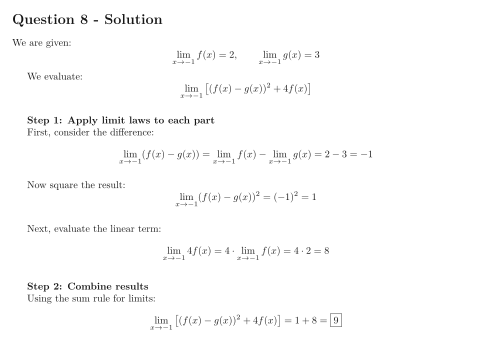
Question 8 Assume the following limits exist: limx→−1f(x)=2,limx→−1g(x)=3\lim_{x \to -1} f(x) = 2, \qquad \lim_{x \to -1} g(x) = 3 Evaluate the limit: limx→−1[(f(x)−g(x))2+4f(x)]\lim_{x \to -1} \left[ (f(x) - g(x))^2 + 4f(x) \right] Use limit laws to justify each step. Show solutionHide solution+Question 8 - Solution We are given: limx→−1f(x)=2,limx→−1g(x)=3\lim_{x \to -1} f(x) = 2, \qquad \lim_{x \to -1} g(x) = 3 We evaluate: limx→−1[(f(x)−g(x))2+4f(x)]\lim_{x \to -1} \left[ (f(x) - g(x))^2 + 4f(x) \right] Step 1: Apply limit laws to each part First, consider the difference: limx→−1(f(x)−g(x))=limx→−1f(x)−limx→−1g(x)=2−3=−1\lim_{x \to -1} (f(x) - g(x)) = \lim_{x \to -1} f(x) - \lim_{x \to -1} g(x) = 2 - 3 = -1 Now square the result: limx→−1(f(x)−g(x))2=(−1)2=1\lim_{x \to -1} (f(x) - g(x))^2 = (-1)^2 = 1 Next, evaluate the linear term: limx→−14f(x)=4⋅limx→−1f(x)=4⋅2=8\lim_{x \to -1} 4f(x) = 4 \cdot \lim_{x \to -1} f(x) = 4 \cdot 2 = 8 Step 2: Combine results Using the sum rule for limits: limx→−1[(f(x)−g(x))2+4f(x)]=1+8=9\lim_{x \to -1} \left[ (f(x) - g(x))^2 + 4f(x) \right] = 1 + 8 = \boxed{9}