Limits Properties — Question 1

PDF ↗

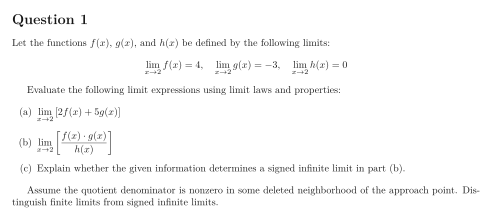
Question 1

Let the functions f(x)f(x), g(x)g(x), and h(x)h(x) be defined by the following limits: limx→2f(x)=4,limx→2g(x)=−3,limx→2h(x)=0\lim_{x \to 2} f(x) = 4, \quad \lim_{x \to 2} g(x) = -3, \quad \lim_{x \to 2} h(x) = 0

Evaluate the following limit expressions using limit laws and properties:

  • (a) lim⁡x→2[2f(x)+5g(x)]\displaystyle\lim_{x \to 2} \left[2f(x) + 5g(x)\right]

  • (b) lim⁡x→2[f(x)⋅g(x)h(x)]\displaystyle\lim_{x \to 2} \left[\frac{f(x) \cdot g(x)}{h(x)}\right]

  • (c) Explain whether the given information determines a signed infinite limit in part (b).

Assume the quotient denominator is nonzero in some deleted neighborhood of the approach point. Distinguish finite limits from signed infinite limits.
Original worksheet page 1: question and worked solution for 2-4-001
Show solutionHide solution

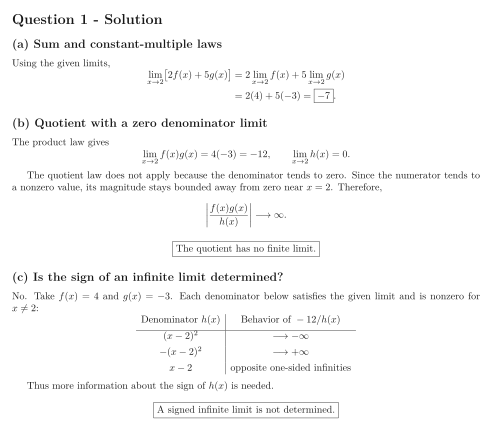
Question 1 - Solution

(a) Sum and constant-multiple laws

Using the given limits, limx→2[2f(x)+5g(x)]=2limx→2f(x)+5limx→2g(x)=2(4)+5(−3)=−7.\begin{aligned} \lim_{x\to2}\bigl[2f(x)+5g(x)\bigr] &=2\lim_{x\to2}f(x)+5\lim_{x\to2}g(x)\\ &=2(4)+5(-3)=\boxed{-7}. \end{aligned}

(b) Quotient with a zero denominator limit

The product law gives limx→2f(x)g(x)=4(−3)=−12,limx→2h(x)=0.\lim_{x\to2}f(x)g(x)=4(-3)=-12, \qquad \lim_{x\to2}h(x)=0.

The quotient law does not apply because the denominator tends to zero. Since the numerator tends to a nonzero value, its magnitude stays bounded away from zero near x=2x=2. Therefore, |f(x)g(x)h(x)|→∞.\left|\frac{f(x)g(x)}{h(x)}\right|\longrightarrow\infty.

The quotient has no finite limit.\boxed{\text{The quotient has no finite limit.}}

(c) Is the sign of an infinite limit determined?

No. Take f(x)=4f(x)=4 and g(x)=−3g(x)=-3. Each denominator below satisfies the given limit and is nonzero for x≠2x\ne2: Denominator h(x)Behavior of −12/h(x)(x−2)2→−∞−(x−2)2→+∞x−2opposite one-sided infinities\begin{array}{c|c} \text{Denominator }h(x)&\text{Behavior of }-12/h(x)\\[4pt]\hline (x-2)^2&\longrightarrow-\infty\\[4pt] -(x-2)^2&\longrightarrow+\infty\\[4pt] x-2&\text{opposite one-sided infinities} \end{array}

Thus more information about the sign of h(x)h(x) is needed. A signed infinite limit is not determined.\boxed{\text{A signed infinite limit is not determined.}}

Original worksheet page 2: question and worked solution for 2-4-001

Original worksheet layout. Use Enlarge or open the PDF for a closer view.